Glad to report that I am back in the saddle. Our time away was very busy; I almost didn't come to work today, but couldn't stay away from blogging ;-).
On the way to General Assembly, we hit several Civil War battlefield sites (my oldest son is a big Civil War nut): Fort Donelson in Dover, Tennessee; Stones River in Murfreesboro, Tennessee; and Kennesaw Mountain near Marietta, Georgia. By the third battlefield, even I was wondering if this was a bit overkill. And yet, at the end of the time, when I asked my son his favorite part of the entire trip, he said the battlefields. So, it was worth it.
For me, General Assembly was very busy. Most of Monday and Tuesday was taken up with the final meeting of Bills and Overtures Committee as it had existed for the first 34 years of the PCA (more on that later). In some ways, our committee meeting was strange--things that shouldn't have taken a lot of time did (we spent almost an hour debating Overture 6, a memorial to honor Ed Clowney); and things that should have taken more time didn't (we spent only 25 minutes debating Overture 17 on whether presbyteries could restrict the right of TEs to teach their "exceptions).
The overtures that took the greatest amount of time were the ones dedicated to the Federal Vision/New Perspective on Paul controvery. We spent nearly 5 hours on Tuesday dealing with these matters. First, the committee took up Overture 26, which was Missouri Presbytery's request that its report be received as information and commended to presbyteries and sessions for study. After a lengthy debate, the committee voted to answer that overture in the negative, in a fashion similar to its answer to the Mississippi Valley report last year. We quickly dispatched Overture 23 on the grounds that the OPC had not yet adopted its justification report and, strictly speaking, hadn't officially released it to public scrutiny and use.
The rest of our time was spent on Overtures 2 and 11, both of which requested a study committee to study Federal Vision/NPP. After a little bit of discussion on smaller issues, it was moved that we answer overture 11 in the affirmative and overture 2 in reference to that action. However, there were some significant difficulties with overture 11: it used the word "heretical" which seemed to suggest that a committee might find heresy; it was both too broad (number of issues to study) and too narrow (brief report in a year).
In addition, some objected to even having a committee. These desired to allow judicial process to play out in the current SJC case. Others suggested that, from their perspective, this really wasn't a big issue and the standards were sufficient. Yet others claimed that a study report wouldn't accomplish anything other than being mere pious advice. The committee couldn't amend 11 enough to make it work; so it tried to make overture 2 work. But in the end, the majority determined (by a 20-17 vote) to answer overtures 11 and 2 in the negative. When we adopted our final report, with the grounds that came before GA, the count was 20-14 and 23-11 (which helps to explain why the number signing the minority report was larger--not everyone was able to make it for the adoption of the final report).
Zack Eswine, TE from Ohio Valley and my colleague here at Covenant Seminary, led the drive for the minority report, authoring the report and recruiting the members. His speech in presenting the report to the General Assembly on Thursday afternoon was masterful; and a number of us spoke in support of the minority. As the vote was taken, I looked around the hall and saw about a 60-40% split in favor of the minority.
The moderator, TE Dominic Aqulia, has the privilege of appointing the study committee, which will include 7 members. It is not yet known whom he will appoint, but my hope is that by drawing on the broad wisdom of our church that we will have a firm and winsome report that clarifies the issues of concern and upholds traditional Presbyterian doctrines and formulations.
The other major action from GA was the adoption of the Strategic Planning Committee's report. Frankly, I was suprised by the large majorities that voted for the SPC's recommendations. In some ways, what the PCA will be doing is an unique experiment in Presbyterian polity: the attempt to hold on to the broad representation of the church on the floor of GA while utilizing the delegated and representative principles that have historically characterized our polity in the new Overtures committee. I don't think anyone is really sure how the whole thing will work.
The other important SPC result was the creation of a Cooperative Ministries Committee which will force our 10 agencies and committees to work together. In my mind, this strikes me as very similar to the SBC Executive Committee, which has representatives from all of the SBC agencies, and I think this new CMC is a step in the right direction. What I hope will be next is a Cooperative Ministries funding plan, again drawing from the SBC Cooperative Program, that will funnel undesignated giving into a common pot for Kingdom purposes. We have to begin to cooperate financial and create a system where monies go both to the national agencies as well as the regional presbyteries if we hope to grow and expand our church in the future.
For me, other highlights of GA include doing my seminar on Presbyterian identity and meeting up with so many friends and colleagues throughout our church. I always come back from these events encouraged in the work of Christ's church. As someone who believes firmly in Presbyterianism, to see this much of the visible church at once gives me hope in the advance of Christ's kingdom around the world.
Tuesday, June 27, 2006

Saturday, June 17, 2006
Away from Blogging
I'll be away from blogging for about ten days, starting today, June 17, and lasting through Monday, June 26. I'll be at the PCA General Assembly in Atlanta and the Association of Theological Schools Biennium in Chicago.
Friday, June 16, 2006
Tony Dungy's Faith
This was an amazing article on Tony Dungy, head coach of the Indianapolis Colts, and his Christian testimony, six months after the suicide of his son, James. Praise the Lord for Coach Dungy.
Tuesday, June 13, 2006
The "Feminization" of American Christianity
Recently, I have been struck anew by how much American Christian leaders have fixated on getting manly men into church. The most recent example of this fixation has been the buzz surrounding David Murrow’s Why Men Hate Going to Church, which garnered attention from the Washington Post. Other books that feed this trend are Leon Podles' The Church Impotent: The Feminization of Christianity, John Elderidge's Wild at Heart: Discovering the Secret of a Man's Soul, and even Douglas Wilson's Future Men. Entire organizations exist to promote "muscular Christainity" and the revival of "masculinity," such as Vision Forum, and websites exist to declare the virtues of patriarchy. Further, one cannot help but see the promotion of complementarianism, by organizations such as the Council on Biblical Manhood and Womanhood, as part of this larger trend toward a reassertion of manly males.
Usually, along with the beliefs that undergird this movement (beliefs, I must note again, that are rooted in 1 Corinthians 10, 11, and 14; 1 Timothy 2:11-15; and Titus 2 and ones that I share) is a larger story of the downfall of American Christianity. Given scholarly support by Ann Douglas's classic 1977 study, The Feminization of American Culture, the declension narrative goes like this: at the end of the 19th century, Victorian culture focused on the subduing of unruly male passions and on the redirection of the outlets for those passions. Hence, temperance became the major battle of the progressive age, which is read as an attempt to shackle men from their natural outlets. In addition, the leaders of that Victorian culture--ironically, ministers and women--authored key novels that idealized virtues that would ultimately serve to de-masculize men (namely, timidity, piety, and a disdain for competition). By replacing passion with timidity, adventure intellectual belief with piety, and survival of the fittest with a disdain for competition, Christianity won the battle of that age, but is now losing the larger war as the next generation of men are leaving the church.
Coupled with this "Feminization" narrative is the larger American movement toward egalitarianism. Beginning at the end of the 19th century and throughout the 20th century, American women have gained larger voices in the political, cultural, and ecclesiastical worlds from which they had been shut out. As they transitioned from leadership of mission's organizations and "women of the church" groups to the leadership of congregations, this is viewed as part of the reason why American men have stopped going to church, why mainline Protestants have lost members in droves, and why the church is in crisis today. The answer, according to these recent books and conservative evangelical leaders, is to "re-masculize" the church, freeing men and their sons to embrace their manhood (by drinking, smoking, risk-taking, and other behaviors in smaller male-oriented groupings or by exercising "male headship" in various leadership roles in family, church, work, etc.).
There are a lot of things to say to this narrative and the larger call for re-masculization. The first thing is this: the historical narrative--not just my generalized summary, but the larger narrative supported by academic scholarship--is simply too thin and places the emphasis in the wrong place. First of all, throughout the history of Christianity from the very beginning, women have had key places in the church and tended to outnumber the men. Read through the NT, read early descriptions of the church from the first and second centuries and you will find a large number of women present. In other words, the "problem" is not new, but as old as the Christian religion.
Rather than concoting a "declension" model, perhaps the better historical question is "why?" What is it about Christianity that attracts more women than men (or others who see themselves as weak, forsaken, abused, and abandoned)? Could it be that Christianity preaches a Gospel that requires people to view themselves as weak, forsaken, helpless, abandoned, destitute? Could it be that such a message is a stumbling block to males who believe they have strength in themselves to save themselves?
But even beyond the questions that could be asked, even the American story is more complex. Because, candidly, male behaviors did need to be address--alcohol was destroying families, unbridled economic competition was destroying the weak, children, and women in the teeming urban centers. 19th century clergy and women leaders (such as Francis Willard, head of the Women's Christian Temperance Union) were responding to real crises. If you will, these leaders were the James Dobsons of their day, trying to help Americans keep their "focus on the family." And so, we need to develop a richer, more complex narrative that doesn't see "declension," but a story of the way things really were.
Another thing to say in response to all this is that the loss of men in the church might be the result, not of the "feminization" of the church, but of the intellectual vacuity of many churches. This was the result of American theology adopting the Kantian dualism between scientific "knowledge" and Christian "faith." Scientific knowledge required the full attention of intellect, while Christian faith was unknowable, a leap in the dark, a decision made at the moment of crisis, a God-consciousness. All that might be nice, but it is not real challenging or attractive: and most men have reacted to this by saying, Give me the intellectual challenge of turning profits, building oil refineries, buying properties. Again, this was the result of intellectual and cultural movements that were not tied to "feminization," but high-brow philosophy and academically sophisticated theology.
Further, and tied with this, I think another reason some men "hate going to church" is, ironically enough, most of our churches have failed to preach the Gospel. I don't mean the Gospel of "Jesus dying for my sins." But I mean the Gospel--an all-encompassing vision of God's invasion into the world to bring his reign to bear on every aspect of life. Such a vision (which right now is going under the label of "missional") is not new--you can find it in Jonathan Edwards' The History of the Work of Redemption, for example. It is a Gospel vision in which human beings recognize their profound dependence upon God for all things and join him in his Kingdom mission of vindicating his name in all the earth. In doing this, God does his good work in the lives of men and women, transforming households, networks, neighborhoods, cities, and the world itself for his glory. By preaching a truncated Gospel, conservative Protestants have ended up in the same place as their liberal brothers (and sisters): with a dualistic vision of the world in which science, business, and law have nothing really to do with the Christian Gospel.
And so, I think the answer to this perception that men hate going to church is not to tell men that Christians like cigars, beer, and movies for men who like movies. Nor is it to lead with "biblical manhood" as a key plank in God's mission to the world (even while recognizing that it is something that needs to be taught and upheld in our churches). Rather, I think the answer is to preach and pray and sell a Gospel vision of what God is doing in this world--because "God has now revealed to us his mysterious plan regarding Christ, a plan to fulfill his own good pleasure. And this is the plan: at the right time he will bring everything together under the authority of Christ--everything in heaven and on earth" (Ephesians 1:9-10 NLT).
This is a plan in which I want to participate: to see Christ "fill all things everywhere with him" and the whole earth be filled with his glory (Ephesians 1:23 NLT). And this is a plan to which men and women everywhere will rally, one that will challenge and bring out the full honor of our genders, personalities, abilities, hopes, and dreams. For it is nothing less than the glorious Gospel purpose of the Triune God.
Usually, along with the beliefs that undergird this movement (beliefs, I must note again, that are rooted in 1 Corinthians 10, 11, and 14; 1 Timothy 2:11-15; and Titus 2 and ones that I share) is a larger story of the downfall of American Christianity. Given scholarly support by Ann Douglas's classic 1977 study, The Feminization of American Culture, the declension narrative goes like this: at the end of the 19th century, Victorian culture focused on the subduing of unruly male passions and on the redirection of the outlets for those passions. Hence, temperance became the major battle of the progressive age, which is read as an attempt to shackle men from their natural outlets. In addition, the leaders of that Victorian culture--ironically, ministers and women--authored key novels that idealized virtues that would ultimately serve to de-masculize men (namely, timidity, piety, and a disdain for competition). By replacing passion with timidity, adventure intellectual belief with piety, and survival of the fittest with a disdain for competition, Christianity won the battle of that age, but is now losing the larger war as the next generation of men are leaving the church.
Coupled with this "Feminization" narrative is the larger American movement toward egalitarianism. Beginning at the end of the 19th century and throughout the 20th century, American women have gained larger voices in the political, cultural, and ecclesiastical worlds from which they had been shut out. As they transitioned from leadership of mission's organizations and "women of the church" groups to the leadership of congregations, this is viewed as part of the reason why American men have stopped going to church, why mainline Protestants have lost members in droves, and why the church is in crisis today. The answer, according to these recent books and conservative evangelical leaders, is to "re-masculize" the church, freeing men and their sons to embrace their manhood (by drinking, smoking, risk-taking, and other behaviors in smaller male-oriented groupings or by exercising "male headship" in various leadership roles in family, church, work, etc.).
There are a lot of things to say to this narrative and the larger call for re-masculization. The first thing is this: the historical narrative--not just my generalized summary, but the larger narrative supported by academic scholarship--is simply too thin and places the emphasis in the wrong place. First of all, throughout the history of Christianity from the very beginning, women have had key places in the church and tended to outnumber the men. Read through the NT, read early descriptions of the church from the first and second centuries and you will find a large number of women present. In other words, the "problem" is not new, but as old as the Christian religion.
Rather than concoting a "declension" model, perhaps the better historical question is "why?" What is it about Christianity that attracts more women than men (or others who see themselves as weak, forsaken, abused, and abandoned)? Could it be that Christianity preaches a Gospel that requires people to view themselves as weak, forsaken, helpless, abandoned, destitute? Could it be that such a message is a stumbling block to males who believe they have strength in themselves to save themselves?
But even beyond the questions that could be asked, even the American story is more complex. Because, candidly, male behaviors did need to be address--alcohol was destroying families, unbridled economic competition was destroying the weak, children, and women in the teeming urban centers. 19th century clergy and women leaders (such as Francis Willard, head of the Women's Christian Temperance Union) were responding to real crises. If you will, these leaders were the James Dobsons of their day, trying to help Americans keep their "focus on the family." And so, we need to develop a richer, more complex narrative that doesn't see "declension," but a story of the way things really were.
Another thing to say in response to all this is that the loss of men in the church might be the result, not of the "feminization" of the church, but of the intellectual vacuity of many churches. This was the result of American theology adopting the Kantian dualism between scientific "knowledge" and Christian "faith." Scientific knowledge required the full attention of intellect, while Christian faith was unknowable, a leap in the dark, a decision made at the moment of crisis, a God-consciousness. All that might be nice, but it is not real challenging or attractive: and most men have reacted to this by saying, Give me the intellectual challenge of turning profits, building oil refineries, buying properties. Again, this was the result of intellectual and cultural movements that were not tied to "feminization," but high-brow philosophy and academically sophisticated theology.
Further, and tied with this, I think another reason some men "hate going to church" is, ironically enough, most of our churches have failed to preach the Gospel. I don't mean the Gospel of "Jesus dying for my sins." But I mean the Gospel--an all-encompassing vision of God's invasion into the world to bring his reign to bear on every aspect of life. Such a vision (which right now is going under the label of "missional") is not new--you can find it in Jonathan Edwards' The History of the Work of Redemption, for example. It is a Gospel vision in which human beings recognize their profound dependence upon God for all things and join him in his Kingdom mission of vindicating his name in all the earth. In doing this, God does his good work in the lives of men and women, transforming households, networks, neighborhoods, cities, and the world itself for his glory. By preaching a truncated Gospel, conservative Protestants have ended up in the same place as their liberal brothers (and sisters): with a dualistic vision of the world in which science, business, and law have nothing really to do with the Christian Gospel.
And so, I think the answer to this perception that men hate going to church is not to tell men that Christians like cigars, beer, and movies for men who like movies. Nor is it to lead with "biblical manhood" as a key plank in God's mission to the world (even while recognizing that it is something that needs to be taught and upheld in our churches). Rather, I think the answer is to preach and pray and sell a Gospel vision of what God is doing in this world--because "God has now revealed to us his mysterious plan regarding Christ, a plan to fulfill his own good pleasure. And this is the plan: at the right time he will bring everything together under the authority of Christ--everything in heaven and on earth" (Ephesians 1:9-10 NLT).
This is a plan in which I want to participate: to see Christ "fill all things everywhere with him" and the whole earth be filled with his glory (Ephesians 1:23 NLT). And this is a plan to which men and women everywhere will rally, one that will challenge and bring out the full honor of our genders, personalities, abilities, hopes, and dreams. For it is nothing less than the glorious Gospel purpose of the Triune God.
Monday, June 12, 2006
Mainline Presbyterians and the Sacraments
The PCA is not the only Presbyterian denomination wrestling with the nature of the sacraments. The mainline Presbyterian Church (USA) has a study committee working these issues as well. They are issuing their report to their General Assembly, meeting in Birmingham, Alabama. For their theological reflections and recommendations, go here and here.
A Godly Hero
[Note: finishing three books in one week is a little unusual; however, we were able to get some time away last weekend. And, now that my grading is done, I feel free to read things that I had wanted to read or things that struck my fancy...]
Why write a biography about a three-time loser who is most well-known in American memory as the prosecuting attorney in the Scopes trial? That question of warrant must challenge any one who would take on the task of writing a book on William Jennings Bryan (1860-1925), three-time Democratic presidential nominee known as "the Great Commoner." Michael Kazin, professor of history at Georgetown University, took up the task with great verve and suggested that in Bryan, progressives might find a way to meld a deep faith in the American people (a la Thomas Jefferson) with a profound faith in Jesus. The result--A Godly Hero: The Life of William Jennings Bryan--is a thoughtful book that charted not only the life of one man, but the times of one of the least studied and understood periods in American history.
Kazin followed Bryan from his small town roots in Salem, Illinois, to Lincoln, Nebraska, where he established a law practice as a precusor to his entrance into politics. And throughout the book, Kazin struggled to explain how Bryan was able to shape the Democratic party for nearly twenty years. Bryan's coming out party was the 1896 Democratic National Convention, where he was swept to the nomination on the strength of his famous "Cross of Gold" speech. And yet, the issues that motivated politics in that year seem strange to moderns--"free silver" and cutting the tariff raised passions that rival modern battles over Iraq, abortion, and tax cuts. Bryan's strength was not the originality of his positions; rather, Kazin suggests that it was Bryan's oratory that propeled him to national prominence, as he gave a voice to Middle America's fears, hopes, and aspiriations.
But it was not simply Bryan's oratory. Rather, Bryan was able to create a soft blend of Social Gospel uplift and progressive political nostrums that won the hearts of a number of people. Able to win the support of theological progressives such as Washington Gladden and Charles Sheldon while holding the respect of Bible-thumpers such as Billy Sunday, Bryan was able to centered his quasi-religious/political message around three key beliefs: belief in the Bible, belief in Jesus, and belief in the people. This led him to propose all sorts of progressive ideals that were co-opted by early 1900s presidents, Republican Theodore Roosevelt and Democrat Woodrow Wilson: progressive income tax; the federal reserve banks; federal insurance for bank deposits; the 8-hour day; child labor laws; and anti-trust regulations.
And so, through Bryan, Kazin is able to describe a great deal of the story of the 1880s to 1920s, the great period of progressivism and populism that transformed American politics and continues to affect modern day conversations. It is hard for moderns to remember a time when economic redistrubution through the progressive income tax was not the law of the land. And it is even more difficult to remember that this policy was seen as a fundamentally Christian one, proposed by Social Gospel follow-travellers such as Will Bryan.
Hence, one of the great ironies of American history is that Bryan has been remembered as a "conservative." Surely that was the result of his two final crusades--prohibition and evolution. And yet, both of these moral arguments were undertaken because Bryan wanted to preserve the purity of the people so that they might be free to do what Jesus would have them do: namely, loving their brothers under the fatherhood of God. Against the various "trusts" that held people down (the money trust; the liquor trust; the "academic" trust), Bryan waged a vigorous battle to make sure that the "people" would be free to pursue virtue. As a result, these two moral battles fit nicely with his political and religious ideology.
One of the interesting questions that struck me was who might be good historical comparison points for understanding Bryan. Two that came to my mind were Abraham Kuyper and Ronald Reagan. Kuyper, the Dutch newspaper man, Reformed intellectual, and Prime Minister, was Bryan's contemporary and shared a great deal of commonalities with the "Great Commoner." One interesting side project would be to compare Kuyper's 1891 speech, "The Problem of Poverty," with Bryan's own progressive diagnosis. Reagan shared Bryan's Illinois roots and his "sunny side of life" perspective, especially their deep and abiding faith in the American people. Perhaps it wouldn't be too much to think that if Bryan could come back to the political scene, as a result of the Reagan Revolution, he might have joined the GOP, rather than the Democracy.
By the end of the book, though, I was still unsure how Kazin would answer that opening question: why write this book? What is the moral of the story? Or to put it differently, does "Christian liberalism" really have a future? Even Kazin appeared unsure. If this book was meant to provide a roadmap for the presumptive 2008 Democratic presidential nominee, then no one should read this book--for in the end, Christian liberalism never got Bryan elected nor did it manage to keep the Democrats in power for long.
Perhaps the real value of the book is to raise the question--which Kazin does quite thoughtfully--whether liberals can be Christians (and conversely, whether Christians can be liberals) at all. If Bryan is any example, then the questions should be answered with a strong affirmative. And if that is the case, then perhaps the modern-day Democracy would do well to invite people of faith into their ranks to care for others with the compassion of Jesus. If they did, their former standard bearer, Will Bryan, would be proud.
Why write a biography about a three-time loser who is most well-known in American memory as the prosecuting attorney in the Scopes trial? That question of warrant must challenge any one who would take on the task of writing a book on William Jennings Bryan (1860-1925), three-time Democratic presidential nominee known as "the Great Commoner." Michael Kazin, professor of history at Georgetown University, took up the task with great verve and suggested that in Bryan, progressives might find a way to meld a deep faith in the American people (a la Thomas Jefferson) with a profound faith in Jesus. The result--A Godly Hero: The Life of William Jennings Bryan--is a thoughtful book that charted not only the life of one man, but the times of one of the least studied and understood periods in American history.
Kazin followed Bryan from his small town roots in Salem, Illinois, to Lincoln, Nebraska, where he established a law practice as a precusor to his entrance into politics. And throughout the book, Kazin struggled to explain how Bryan was able to shape the Democratic party for nearly twenty years. Bryan's coming out party was the 1896 Democratic National Convention, where he was swept to the nomination on the strength of his famous "Cross of Gold" speech. And yet, the issues that motivated politics in that year seem strange to moderns--"free silver" and cutting the tariff raised passions that rival modern battles over Iraq, abortion, and tax cuts. Bryan's strength was not the originality of his positions; rather, Kazin suggests that it was Bryan's oratory that propeled him to national prominence, as he gave a voice to Middle America's fears, hopes, and aspiriations.
But it was not simply Bryan's oratory. Rather, Bryan was able to create a soft blend of Social Gospel uplift and progressive political nostrums that won the hearts of a number of people. Able to win the support of theological progressives such as Washington Gladden and Charles Sheldon while holding the respect of Bible-thumpers such as Billy Sunday, Bryan was able to centered his quasi-religious/political message around three key beliefs: belief in the Bible, belief in Jesus, and belief in the people. This led him to propose all sorts of progressive ideals that were co-opted by early 1900s presidents, Republican Theodore Roosevelt and Democrat Woodrow Wilson: progressive income tax; the federal reserve banks; federal insurance for bank deposits; the 8-hour day; child labor laws; and anti-trust regulations.
And so, through Bryan, Kazin is able to describe a great deal of the story of the 1880s to 1920s, the great period of progressivism and populism that transformed American politics and continues to affect modern day conversations. It is hard for moderns to remember a time when economic redistrubution through the progressive income tax was not the law of the land. And it is even more difficult to remember that this policy was seen as a fundamentally Christian one, proposed by Social Gospel follow-travellers such as Will Bryan.
Hence, one of the great ironies of American history is that Bryan has been remembered as a "conservative." Surely that was the result of his two final crusades--prohibition and evolution. And yet, both of these moral arguments were undertaken because Bryan wanted to preserve the purity of the people so that they might be free to do what Jesus would have them do: namely, loving their brothers under the fatherhood of God. Against the various "trusts" that held people down (the money trust; the liquor trust; the "academic" trust), Bryan waged a vigorous battle to make sure that the "people" would be free to pursue virtue. As a result, these two moral battles fit nicely with his political and religious ideology.
One of the interesting questions that struck me was who might be good historical comparison points for understanding Bryan. Two that came to my mind were Abraham Kuyper and Ronald Reagan. Kuyper, the Dutch newspaper man, Reformed intellectual, and Prime Minister, was Bryan's contemporary and shared a great deal of commonalities with the "Great Commoner." One interesting side project would be to compare Kuyper's 1891 speech, "The Problem of Poverty," with Bryan's own progressive diagnosis. Reagan shared Bryan's Illinois roots and his "sunny side of life" perspective, especially their deep and abiding faith in the American people. Perhaps it wouldn't be too much to think that if Bryan could come back to the political scene, as a result of the Reagan Revolution, he might have joined the GOP, rather than the Democracy.
By the end of the book, though, I was still unsure how Kazin would answer that opening question: why write this book? What is the moral of the story? Or to put it differently, does "Christian liberalism" really have a future? Even Kazin appeared unsure. If this book was meant to provide a roadmap for the presumptive 2008 Democratic presidential nominee, then no one should read this book--for in the end, Christian liberalism never got Bryan elected nor did it manage to keep the Democrats in power for long.
Perhaps the real value of the book is to raise the question--which Kazin does quite thoughtfully--whether liberals can be Christians (and conversely, whether Christians can be liberals) at all. If Bryan is any example, then the questions should be answered with a strong affirmative. And if that is the case, then perhaps the modern-day Democracy would do well to invite people of faith into their ranks to care for others with the compassion of Jesus. If they did, their former standard bearer, Will Bryan, would be proud.
Friday, June 09, 2006
Open Secrets
When I was a junior in college, I spent the summer as a youth minister at a small, country independent church in New Castle, Indiana. For a kid who had grown up in upper-middle class suburbia, living in an old farm house, making $125 a week, and relating to retired farmers and factory workers was akin to cross-cultural ministry. It took effort to spend time listening and valuing those believers, who surely looked at me as a pampered 20-year old who never worked hard a day in his life.
What I discovered was that there was a real strength and wisdom that came from these men and women. They had real knowledge, though it was different from the book learning that I had absorbed. And over time, both in Indiana and Kentucky and through my wife who was a country girl (at least, she was more country than I was), I recognized how valuable, how wise, farm people were.
It was this journey of discovery that Richard Lischer described in his memior, Open Secrets. Lischer, the James T. and Alice Mead Cleland Professor of Preaching at Duke Divinity School, took little Cana Lutheran Church, at an unmarked crossroads outside of Alton, Illionis, as his first pastoral ministry. A St. Louis native, fresh off doctoral studies at University of London, where he wrote his dissertation on Marx and Telihard (hard to imagine something more irrelevant for rural pastoral ministry than that), he learned the joys and trials of caring for a people and place so different from what he knew previously.
In Open Secrets, we discovered faithful laypeople like Leonard Semanns, who confronted his pastor when Lischer agreed to teach for the renegade and progressive Seminex, the "Concordia Seminary in exile" during the 1970s battle for the Bible in the Lutheran Church-Missouri Synod; the sometimes abusive and despairing family life of people like Buster and Beulah; the unwanted pregancies, the dying and yet faithful members, the loneliness of older men who lose their wives and the tenancity of older women who lose their husbands. We felt the undercurrents of battle between leaders who remain in rural communities and pastors who leave after a time, the challenge of authority and leadership in those situations, and the hurt that can simmer under the surface.
Above all, Lischer opened up both the romance and mundanity of pastoral ministry--to know the struggle of trying to make Christianity relevant to the lives of parishioners and feel the tinge of failure. Until that moment when crisis strikes--and then God allows his pastors to be sacraments of grace to God's own people, confirming and assuring them of God's continuing promise of presence, forgiveness, and mercy. Not only this, but Lischer described a vision of pastoral ministry that also meant straining to see the smallest of signs that God's grace, like a small planting of corn or beans or lettuce, is growing in people's lives. You need eyes to see it, for it shows up in unexpected places and ways--but God's work in his people can serve as God's sacrament of grace to his ministers as well (cf. Romans 1:12).
In doing this and sharing God's open secret in and through ministry to his body, God used Lischer to renew my own sense of pastoral calling once again: to serve as God's agent of Gospel reconcilation to hurting people whom God loves passionately and unreservedly. For every pastor who sometimes struggles with why he is in ministry, this book can't be read soon enough.
What I discovered was that there was a real strength and wisdom that came from these men and women. They had real knowledge, though it was different from the book learning that I had absorbed. And over time, both in Indiana and Kentucky and through my wife who was a country girl (at least, she was more country than I was), I recognized how valuable, how wise, farm people were.
It was this journey of discovery that Richard Lischer described in his memior, Open Secrets. Lischer, the James T. and Alice Mead Cleland Professor of Preaching at Duke Divinity School, took little Cana Lutheran Church, at an unmarked crossroads outside of Alton, Illionis, as his first pastoral ministry. A St. Louis native, fresh off doctoral studies at University of London, where he wrote his dissertation on Marx and Telihard (hard to imagine something more irrelevant for rural pastoral ministry than that), he learned the joys and trials of caring for a people and place so different from what he knew previously.
In Open Secrets, we discovered faithful laypeople like Leonard Semanns, who confronted his pastor when Lischer agreed to teach for the renegade and progressive Seminex, the "Concordia Seminary in exile" during the 1970s battle for the Bible in the Lutheran Church-Missouri Synod; the sometimes abusive and despairing family life of people like Buster and Beulah; the unwanted pregancies, the dying and yet faithful members, the loneliness of older men who lose their wives and the tenancity of older women who lose their husbands. We felt the undercurrents of battle between leaders who remain in rural communities and pastors who leave after a time, the challenge of authority and leadership in those situations, and the hurt that can simmer under the surface.
Above all, Lischer opened up both the romance and mundanity of pastoral ministry--to know the struggle of trying to make Christianity relevant to the lives of parishioners and feel the tinge of failure. Until that moment when crisis strikes--and then God allows his pastors to be sacraments of grace to God's own people, confirming and assuring them of God's continuing promise of presence, forgiveness, and mercy. Not only this, but Lischer described a vision of pastoral ministry that also meant straining to see the smallest of signs that God's grace, like a small planting of corn or beans or lettuce, is growing in people's lives. You need eyes to see it, for it shows up in unexpected places and ways--but God's work in his people can serve as God's sacrament of grace to his ministers as well (cf. Romans 1:12).
In doing this and sharing God's open secret in and through ministry to his body, God used Lischer to renew my own sense of pastoral calling once again: to serve as God's agent of Gospel reconcilation to hurting people whom God loves passionately and unreservedly. For every pastor who sometimes struggles with why he is in ministry, this book can't be read soon enough.
Thursday, June 08, 2006
The Challenge of Denominational Identity
Next week is the Southern Baptist Convention, which will meet in Greensboro, NC. As you may know, the SBC has been experiencing tremors on a variety of issues since 2000, most centering on the influence of Calvinism, its relationship to evangelism, and the future of the "conservative resurgence," now in leadership for 15 years. The Florida Baptist Witness asked several leaders--both denominational higher-ups and young emerging leaders--what they hoped for in the upcoming SBC. And the answers not only reveal the divergence among SBC leaders, but also the continuing challenge of communicating denominational identity to the next generation.
The denominational leaders all stressed that they hoped the upcoming SBC would unite messengers around a missions and evangelism vision; this, of course, is the Southern Baptist way, forging identity around missions and evangelism, rather than doctrinal particularity. The "outsiders," both younger SBC leaders and those who are slightly out of step with denominational leadership, dissented from the leaders by stressing either other values--the need for repentence, for doctrinal particularity, for a reversal of nominal Christianity. Still others warn that if Southern Baptist ministers don't stop fighting with each other, the younger generation will bolt.
And that really is the problem in the end--throughout the 1990s, as Southern Baptist seminaries experienced the transition from progressive to conservative faculty and administration, "loyal" (i.e. progressive) Southern Baptist stopped sending students to these seminaries and created new ones attached to progressive-controlled colleges and universities. Meanwhile, in order to maintain enrollment at the SBC seminaries, these schools recruited a large number of baptistic and Calvinistic evangelicals as faculty and students. These folks had no deep commitments to SBC identity, to the beliefs, practices, and stories that make Southern Baptists a unique family in American Protestantism (one faculty member was reported to have asked the question, "I hear everyone talking about Nashville. What's in Nashville?").
The upshot of all this has been that as the SBC has sought to be and do what they have always been and done, younger Southern Baptists, who have no loyalties to the denomination and its identity, wonder why in the world they are still in the SBC. Southern Baptist in-fighting might eventually drive them away. This is why Al Mohler perpeptively observed "I think this meeting of the convention may also show us something of the challenge we face in terms of reaching out to younger Southern Baptists and in dealing with some of the crucial issues of this transitional age — a time that should find Southern Baptists at their best." He recognizes that younger Southern Baptists are on the fence and are not genuinely loyal to the SBC, because they haven't truly be shaped by SBC identity.
Now, I am writing all this not to throw rocks at anyone. Rather, it is to make the application to my own denomination and its recent Presbyterians Together document. One of the striking realities of that document was how many students and younger ministers signed on to the ideals of charity and diversity in doctrine and unity in mission. In this regard, younger PCA ministers and candidates are not different from their SBC colleagues--because they came to Presbyterianism in college or through other means, they don't have deep attachements to "being Presbyterian." As a result, they don't understand why the PCA feels the need to wrestle with doctrinal issues. And so, it is entirely conceivable that if we spend too much time arguing with one another, these younger ministers will leave the PCA.
The solution, in my view, is not to avoid doctrinal discussions in order to maintain big-tent Presbyterianism. Rather, the solution is to instruct younger ministers patiently in the joys of being Presbyterian--that, in my view, Presbyterians is the most positive and biblical witness to the world possible; that this is because, at bottom, Presbyterianism means working together in a connectional way for the good of the church and the world; that Presbyterian means (or ought to mean) community and authenticity and accountability and all the things this generation says they want. Sure, being Presbyterian also means doing things decently and in order, within a process, working with others--but that is the hard work of community and it is a good thing. In other words, the task for PCA denominational leaders is to take the time to present a positive vision of Presbyterian identity.
In my experience, I have found that most of our ministerial candidates long for this positive vision. By presenting a vision of something far greater than ourselves--with a glorious identity that stretches back to heroic ages and forward to the final form of God's Kingdom--I believe this coming generation could foster biblical, joyful, and energized Presbyterianism for the good of the world.
The denominational leaders all stressed that they hoped the upcoming SBC would unite messengers around a missions and evangelism vision; this, of course, is the Southern Baptist way, forging identity around missions and evangelism, rather than doctrinal particularity. The "outsiders," both younger SBC leaders and those who are slightly out of step with denominational leadership, dissented from the leaders by stressing either other values--the need for repentence, for doctrinal particularity, for a reversal of nominal Christianity. Still others warn that if Southern Baptist ministers don't stop fighting with each other, the younger generation will bolt.
And that really is the problem in the end--throughout the 1990s, as Southern Baptist seminaries experienced the transition from progressive to conservative faculty and administration, "loyal" (i.e. progressive) Southern Baptist stopped sending students to these seminaries and created new ones attached to progressive-controlled colleges and universities. Meanwhile, in order to maintain enrollment at the SBC seminaries, these schools recruited a large number of baptistic and Calvinistic evangelicals as faculty and students. These folks had no deep commitments to SBC identity, to the beliefs, practices, and stories that make Southern Baptists a unique family in American Protestantism (one faculty member was reported to have asked the question, "I hear everyone talking about Nashville. What's in Nashville?").
The upshot of all this has been that as the SBC has sought to be and do what they have always been and done, younger Southern Baptists, who have no loyalties to the denomination and its identity, wonder why in the world they are still in the SBC. Southern Baptist in-fighting might eventually drive them away. This is why Al Mohler perpeptively observed "I think this meeting of the convention may also show us something of the challenge we face in terms of reaching out to younger Southern Baptists and in dealing with some of the crucial issues of this transitional age — a time that should find Southern Baptists at their best." He recognizes that younger Southern Baptists are on the fence and are not genuinely loyal to the SBC, because they haven't truly be shaped by SBC identity.
Now, I am writing all this not to throw rocks at anyone. Rather, it is to make the application to my own denomination and its recent Presbyterians Together document. One of the striking realities of that document was how many students and younger ministers signed on to the ideals of charity and diversity in doctrine and unity in mission. In this regard, younger PCA ministers and candidates are not different from their SBC colleagues--because they came to Presbyterianism in college or through other means, they don't have deep attachements to "being Presbyterian." As a result, they don't understand why the PCA feels the need to wrestle with doctrinal issues. And so, it is entirely conceivable that if we spend too much time arguing with one another, these younger ministers will leave the PCA.
The solution, in my view, is not to avoid doctrinal discussions in order to maintain big-tent Presbyterianism. Rather, the solution is to instruct younger ministers patiently in the joys of being Presbyterian--that, in my view, Presbyterians is the most positive and biblical witness to the world possible; that this is because, at bottom, Presbyterianism means working together in a connectional way for the good of the church and the world; that Presbyterian means (or ought to mean) community and authenticity and accountability and all the things this generation says they want. Sure, being Presbyterian also means doing things decently and in order, within a process, working with others--but that is the hard work of community and it is a good thing. In other words, the task for PCA denominational leaders is to take the time to present a positive vision of Presbyterian identity.
In my experience, I have found that most of our ministerial candidates long for this positive vision. By presenting a vision of something far greater than ourselves--with a glorious identity that stretches back to heroic ages and forward to the final form of God's Kingdom--I believe this coming generation could foster biblical, joyful, and energized Presbyterianism for the good of the world.
Tuesday, June 06, 2006
Mayflower
In fast-paced and crackling prose, Nathaniel Philbrick's Mayflower narrates the first 50 years of the Plymouth plantation. Stripping away the mythology of righteous Pilgrims and noble Indians, Philbrick's book focuses on the challenges of interracial exchange and the difficulties of living together in harmony. And yet, in his focus on this larger theme, Philbrick never strays too far away from telling a good story--indeed, it is the story-telling that is the book's great strength.
Opening with the first Mayflower migrants and focusing especially on William Bradford, Philbrick skillfully relates the challenges of the first year at Plymouth Plantation. Indeed, if it were not for the relationship developed with Massasoit and the Pokanokets, the first settlers would have been destroyed, either by the elements, lack of food, or the natives themselves. This interracial cooperation allowed English and Natives to coexist in a relatively peaceful manner until the 1637 Pequot war outside of Boston.
As the first generation of English and Natives pass off the scene, the next generation struggles to find each other. Especially as Plymouth is ruled by Josiah Winslow (founding generation Edward Winslow's son) and as the Ponkankets are led by Alexander and then Philip, old alliances are forsaken, distrust is the rule, and war breaks out. "King Philip's War," as it was called, destroyed the previous interracial balance and, in the two years of 1675-6, changed the power structure of New England.
One of the most noteworthy points that the book raises is how the alliances were never English versus Natives, but were far more complex. Key in this complexity were the "Praying Indians," those Natives who aligned themselves with Christianity as taught by John Eliot and who dwelt in the "Praying towns" set aside for Indian Missions. During King Philip's War, they were important allies for the English and belied their commitment to Christ's commands for peace in their brutal defeat of their Native enemies.
Also important were the various informal agreements made, most importantly between Benjamin Church (an English military leader) and Awashonks (the female sachem of the Sakonnets). By bringing the Sakonnets in on the side of the English and learning the Native ways of fighting, the Plymouth leaders were finally able to break the Pan-Indian alliance seemingly bent for their destruction.
While there was a great deal of scholarship that undergird this breezy telling, one of the great disappointments was Philbrick's clumsy handling of religious themes. Indeed, aside from a few pages at the beginning, one gets little sense of the Pilgrim's religious views. And so, Philbrick's presentation of their theological understanding is fairly wooden--every defeat of the Natives was attributed to the blessing of God; any working together with other Protestants was anathema; and at the end of the day, in Philbrick's telling, the Pilgrims were borderline fanatics, premodern fundamentalists, if you will. One gets the sense that the Pilgrim's religious views were a frustrating impediment to a rousing story; the sooner they could be shunted to the side, the better.
Likewise, while the great moral of the story--the need for interracial cooperation and negotiation, rather than fear and war--seemed particularly appropriate in a post-9/11 world, Philbrick could have done more to bubble that theme to the surface. Perhaps a weakness of the book is that one could have read this book six years ago and not picked up on that theme at all.
Still, for those who know very little about the first 50 years of life in New England, this book is a worthwhile addition to the "popular history" genre, developed so well by Stephen Ambrose. One cannot help but be impressed by the synthetic nature of the book and the fast-paced story. In the end, Mayflower was enjoyable read, even when it failed to ask or answer the big questions about God, providence, and life in this world.
Opening with the first Mayflower migrants and focusing especially on William Bradford, Philbrick skillfully relates the challenges of the first year at Plymouth Plantation. Indeed, if it were not for the relationship developed with Massasoit and the Pokanokets, the first settlers would have been destroyed, either by the elements, lack of food, or the natives themselves. This interracial cooperation allowed English and Natives to coexist in a relatively peaceful manner until the 1637 Pequot war outside of Boston.
As the first generation of English and Natives pass off the scene, the next generation struggles to find each other. Especially as Plymouth is ruled by Josiah Winslow (founding generation Edward Winslow's son) and as the Ponkankets are led by Alexander and then Philip, old alliances are forsaken, distrust is the rule, and war breaks out. "King Philip's War," as it was called, destroyed the previous interracial balance and, in the two years of 1675-6, changed the power structure of New England.
One of the most noteworthy points that the book raises is how the alliances were never English versus Natives, but were far more complex. Key in this complexity were the "Praying Indians," those Natives who aligned themselves with Christianity as taught by John Eliot and who dwelt in the "Praying towns" set aside for Indian Missions. During King Philip's War, they were important allies for the English and belied their commitment to Christ's commands for peace in their brutal defeat of their Native enemies.
Also important were the various informal agreements made, most importantly between Benjamin Church (an English military leader) and Awashonks (the female sachem of the Sakonnets). By bringing the Sakonnets in on the side of the English and learning the Native ways of fighting, the Plymouth leaders were finally able to break the Pan-Indian alliance seemingly bent for their destruction.
While there was a great deal of scholarship that undergird this breezy telling, one of the great disappointments was Philbrick's clumsy handling of religious themes. Indeed, aside from a few pages at the beginning, one gets little sense of the Pilgrim's religious views. And so, Philbrick's presentation of their theological understanding is fairly wooden--every defeat of the Natives was attributed to the blessing of God; any working together with other Protestants was anathema; and at the end of the day, in Philbrick's telling, the Pilgrims were borderline fanatics, premodern fundamentalists, if you will. One gets the sense that the Pilgrim's religious views were a frustrating impediment to a rousing story; the sooner they could be shunted to the side, the better.
Likewise, while the great moral of the story--the need for interracial cooperation and negotiation, rather than fear and war--seemed particularly appropriate in a post-9/11 world, Philbrick could have done more to bubble that theme to the surface. Perhaps a weakness of the book is that one could have read this book six years ago and not picked up on that theme at all.
Still, for those who know very little about the first 50 years of life in New England, this book is a worthwhile addition to the "popular history" genre, developed so well by Stephen Ambrose. One cannot help but be impressed by the synthetic nature of the book and the fast-paced story. In the end, Mayflower was enjoyable read, even when it failed to ask or answer the big questions about God, providence, and life in this world.
Friday, June 02, 2006
Jonathan Edwards Center Blog
For those of you who may not be aware, the Jonathan Edwards Center at Yale University has an excellent blog that notices Edwards resources all over the internet. Highly recommended.
Grateful living before God and for others
From Miroslav Volf's Free of Charge, p. 36:
"Assertion of independence, pride of achievement, sense of entitlement, an absolute right to dispose with our goods--these are the ways in which we live in contradiction to who we actually are in relation to God. And in these ways, we, decent citizens, live as inveterate sinners. To live in sync with who we truly are means to recognize that we are dependent on God for our very breath and are grace with many good things; it means to be grateful to the giver and attentive to the purpose for which the gifts are given."
"Assertion of independence, pride of achievement, sense of entitlement, an absolute right to dispose with our goods--these are the ways in which we live in contradiction to who we actually are in relation to God. And in these ways, we, decent citizens, live as inveterate sinners. To live in sync with who we truly are means to recognize that we are dependent on God for our very breath and are grace with many good things; it means to be grateful to the giver and attentive to the purpose for which the gifts are given."
Thursday, June 01, 2006
Prayer for the Cubs?
This was a very thought-provoking post, especially in the light of what I wrote a few days ago about praying for Barbaro. In particular, I was struck by this comment: "That the relative outcome of a baseball team is part of God's decree, his sovereign control in providence of everything that happens, is beyond question. But to suggest that the fortunes of a baseball team are indicative of answered prayer is, well, a stretch to say the least."
On one level, we would want to agree and say, "Well, of course praying for the Cubs' (or for any baseball team's) success is a pointless venture" (and I would especially affirm this as a St. Louis Cardinals fan). But would we really want to carry this out logically? For example, do we really want to say that the fortunes of a business are more important to God than the fortunes of a baseball team? Should I pray for my dad's business to succeed, but not for a friend's baseball team (a number of the Cardinals, for example, are believers)? Where do we draw the line?
Further, would it be "wrong" for the Christians on the Cubs to pray for their own team's success? Would it be wrong for a Christian business owner, who has a RFP out to another company, to pray that he wins the bid? Would it be wrong for a family to pray that their house sells quickly and at a good price (and so, they would "win" in the marketplace)?
I tend to think that if we begin to divide between "truly spiritual" prayer requests and less spiritual requests, then we will begin to believe that somehow our "regular" lives really aren't that important to God. And so, we no longer present our desires to God, we no longer carry on conversations with God; rather, we wait for those things that are "truly important," which ultimately means we will never really pray at all.
I also tend to think that if we were to take this all to its extreme, then it would give us a much smaller view of God. Suddenly our God is not intimately involved in our lives, granting us daily bread and minor victories as tokens of his great love and care; rather, we begin to believe that God is transcendent, other, and far too busy to think that the things I care about matter in the grand cosmic scheme of things. Our hearts come to reason, "Sure, he has decreed it all to happen, but he doesn't really care much about it and so, why should you?"
Now, I do believe that as we follow after Jesus, we learn to order our desires after God's own heart and so we learn to pray out of the great categories of the Lord's prayer. As a result, our hearts will not be crushed when our favorite team loses the World Series (like in 2004); our teams are not idols that take the place of the true and living God.
Still, if our God cares about lillies of the field as they wave in a swift breeze and about birds of the air as they frolic in the warm summer days, he surely cares about his own creatures as they run the bases, throw the ball, and smack game-winning hits. And because we enjoy such a relationship with our God, we can take all of these things to him in Jesus' name. Even Cubs fans.
On one level, we would want to agree and say, "Well, of course praying for the Cubs' (or for any baseball team's) success is a pointless venture" (and I would especially affirm this as a St. Louis Cardinals fan). But would we really want to carry this out logically? For example, do we really want to say that the fortunes of a business are more important to God than the fortunes of a baseball team? Should I pray for my dad's business to succeed, but not for a friend's baseball team (a number of the Cardinals, for example, are believers)? Where do we draw the line?
Further, would it be "wrong" for the Christians on the Cubs to pray for their own team's success? Would it be wrong for a Christian business owner, who has a RFP out to another company, to pray that he wins the bid? Would it be wrong for a family to pray that their house sells quickly and at a good price (and so, they would "win" in the marketplace)?
I tend to think that if we begin to divide between "truly spiritual" prayer requests and less spiritual requests, then we will begin to believe that somehow our "regular" lives really aren't that important to God. And so, we no longer present our desires to God, we no longer carry on conversations with God; rather, we wait for those things that are "truly important," which ultimately means we will never really pray at all.
I also tend to think that if we were to take this all to its extreme, then it would give us a much smaller view of God. Suddenly our God is not intimately involved in our lives, granting us daily bread and minor victories as tokens of his great love and care; rather, we begin to believe that God is transcendent, other, and far too busy to think that the things I care about matter in the grand cosmic scheme of things. Our hearts come to reason, "Sure, he has decreed it all to happen, but he doesn't really care much about it and so, why should you?"
Now, I do believe that as we follow after Jesus, we learn to order our desires after God's own heart and so we learn to pray out of the great categories of the Lord's prayer. As a result, our hearts will not be crushed when our favorite team loses the World Series (like in 2004); our teams are not idols that take the place of the true and living God.
Still, if our God cares about lillies of the field as they wave in a swift breeze and about birds of the air as they frolic in the warm summer days, he surely cares about his own creatures as they run the bases, throw the ball, and smack game-winning hits. And because we enjoy such a relationship with our God, we can take all of these things to him in Jesus' name. Even Cubs fans.
Wednesday, May 31, 2006
The Civil War as Theological Crisis
In his magnum opus, America’s God: From Jonathan Edwards to Abraham Lincoln (2002), Mark Noll argued that the American synthesis of Christian republicanism, experimental Calvinism, and common sense realism foundered on the complex of events that we know as the Civil War. Specifically, the intractable problem of slavery—and how Bible-believing Protestants dealt with that problem through scriptural interpretation—served as a theological crisis of the first-order that brought the American theological synthesis into deep question and ultimately led many intellectuals to abandon it all together.
In that book, Noll’s telling felt partial and unfulfilling. I, for one, questioned whether the Civil War was in fact a significant catalyst for theological crisis: “To be sure, the Civil War was consequential as a social and cultural transformative catalyst. Still, there were other intellectual trends that led to the break-up of the American theology in postbellum America, ones that Noll would have done well to incorporate into this synthetic study” (in Fides et Historia [2003]: 141-3).
That being said, in his new book, The Civil War as a Theological Crisis (2006), Noll provided the goods that sustained his claim that the American Civil War proved to be a theological crisis of the first-order. Originally presented as the Steven and Janice Brose Lectures at Penn State University in 2003, Noll gave the first sustained examination of biblical and theological scholarship in the period leading up to and including the Civil War since Eugene Genovese’s 1985 lectures at Gettysburg College (“Slavery Ordained of God”: The Southern Slaveholders’ View of Biblical History and Modern Politics [1985]). In so doing, he offered an important corrective to Genovese as well as needed nuance to his own understanding of the flaws of the proslavery argument.
Indeed, it is just here where Noll succeeded brilliantly. Paying close attention to alternative voices—African American theologians as well as American and international Protestant and Catholic intellectuals—Noll distinguished between "slavery in the abstract" and American slavery, which was always race-based slavery. Because American slavery was always race-based and always for life, it could never fully satisfy biblical mandates. He also masterfully described the problems of providence, its relation to the American experiment, and how that experiment was tied to and compromised by slavery: did God providentially allow and so sanctify slavery? Was the movement of history to eliminate slavery and establish liberal democracy?
At the crux of this theological crisis was the matter of authority—what do Christians do when interpretations of the Bible and providence conflict? With the problem of slavery, American Christians allowed the great theologians Grant, Sherman, and Lee decided these biblical and moral issues on the battlefield. And this highlighted the crisis—because American Christians were compromised by social and economic location in such a way that they could not think clearly and biblically on matters related to race and slavery, it suggested that liberal democracy and Christian republicanism was not sufficient for biblical interpretation. Some outside authority was needed to resolve the conflict without recourse to arms.
One cannot help but wonder if Noll meant for the Roman Catholics to be the “heroes” of this story, the ones who were able to see more clearly than Protestants on either side of the Atlantic. That was the effect of his story; as a Protestant, it made me want to point out that Catholic conservatism could also be culturally captive, as evidenced by the fact that 20th century Italian Catholics were quite friendly to fascism in its German and Italian forms. Still, by demonstrating that the crisis which the Civil War provoked was one of authority, Noll could rightly tie this intellectual crisis to other contemporary movements that were also challenging biblical authority (see, for example, James Turner’s Without God, Without Creed: The Origins of Unbelief in America [1985]).
As a result, this book was deeply satisfying and profoundly disturbing all at the same time. It is to his credit that Noll’s evangelical scholarship can so well investigate such intellectual complexities and question such moral scandals.
In that book, Noll’s telling felt partial and unfulfilling. I, for one, questioned whether the Civil War was in fact a significant catalyst for theological crisis: “To be sure, the Civil War was consequential as a social and cultural transformative catalyst. Still, there were other intellectual trends that led to the break-up of the American theology in postbellum America, ones that Noll would have done well to incorporate into this synthetic study” (in Fides et Historia [2003]: 141-3).
That being said, in his new book, The Civil War as a Theological Crisis (2006), Noll provided the goods that sustained his claim that the American Civil War proved to be a theological crisis of the first-order. Originally presented as the Steven and Janice Brose Lectures at Penn State University in 2003, Noll gave the first sustained examination of biblical and theological scholarship in the period leading up to and including the Civil War since Eugene Genovese’s 1985 lectures at Gettysburg College (“Slavery Ordained of God”: The Southern Slaveholders’ View of Biblical History and Modern Politics [1985]). In so doing, he offered an important corrective to Genovese as well as needed nuance to his own understanding of the flaws of the proslavery argument.
Indeed, it is just here where Noll succeeded brilliantly. Paying close attention to alternative voices—African American theologians as well as American and international Protestant and Catholic intellectuals—Noll distinguished between "slavery in the abstract" and American slavery, which was always race-based slavery. Because American slavery was always race-based and always for life, it could never fully satisfy biblical mandates. He also masterfully described the problems of providence, its relation to the American experiment, and how that experiment was tied to and compromised by slavery: did God providentially allow and so sanctify slavery? Was the movement of history to eliminate slavery and establish liberal democracy?
At the crux of this theological crisis was the matter of authority—what do Christians do when interpretations of the Bible and providence conflict? With the problem of slavery, American Christians allowed the great theologians Grant, Sherman, and Lee decided these biblical and moral issues on the battlefield. And this highlighted the crisis—because American Christians were compromised by social and economic location in such a way that they could not think clearly and biblically on matters related to race and slavery, it suggested that liberal democracy and Christian republicanism was not sufficient for biblical interpretation. Some outside authority was needed to resolve the conflict without recourse to arms.
One cannot help but wonder if Noll meant for the Roman Catholics to be the “heroes” of this story, the ones who were able to see more clearly than Protestants on either side of the Atlantic. That was the effect of his story; as a Protestant, it made me want to point out that Catholic conservatism could also be culturally captive, as evidenced by the fact that 20th century Italian Catholics were quite friendly to fascism in its German and Italian forms. Still, by demonstrating that the crisis which the Civil War provoked was one of authority, Noll could rightly tie this intellectual crisis to other contemporary movements that were also challenging biblical authority (see, for example, James Turner’s Without God, Without Creed: The Origins of Unbelief in America [1985]).
As a result, this book was deeply satisfying and profoundly disturbing all at the same time. It is to his credit that Noll’s evangelical scholarship can so well investigate such intellectual complexities and question such moral scandals.
Generational Difference and Complementarianism
Mark Dever has a striking set of observations on a pastor's colloquium which he (and I) attended in which the issue of complementarianism divided the room. While most of the attendees agreed in substance with the idea that only men should serve as ordained pastors, there was a difference in strategy and presentation. Dever went on to observe that "those older than me who are complementarian generally want to downplay this issue, and those younger than me want to lead with it, or at least be very up front about it."
Let me say first of all that I agree essentially with the complementarian position. Having wrestled at length with the egalitarian exegesis of 1 Timothy 2:11-15, I find a great deal of it unconvincing. I believe that Paul argues there that when it comes to the authorative transmission of God's Word in the public worship of God's people, God affirms male leadership. This has nothing to do with the respective value of men and women and everything to do with order, both creational and contemporary order. Further, while I affirm that only men should exercise ordained leadership, Paul (and for that matter, God) places a high value on women's ministry gifts and envisions a large role for them in the church's life together (as in 1 Timothy 5:1-16). So, I affirm the basic complementarian position.
That being said, I disagree with Mark's observation. I think in Southern Baptist circles, where professors, church leaders, and others have made this a huge issue for the church, younger men see this as a dividing line for the gospel (when you have someone as godly and smart as Tom Schriener observing in one book that this is the crucial Gospel issue for this generation, it is hard for younger men to differ). However, as one who is a few years younger than Mark and who serves in different circles, the younger men with whom I serve do not see this as the dividing line issue. And frankly, neither do I.
In fact, I think we make a big mistake when we lead with this issue--unconverted, secular people won't understand issues related to creational, family, and church order until they first understand their own great need for Jesus. Once they have been transformed by the Gospel of Jesus, then as they are instructed in God's Word, we can teach them about how God desires his household to be ordered. But to make a matter of family and church order central strikes me as creating unnecessary walls for secular people to leap in order to come to faith in Jesus.
In this regard, J. Gresham Machen is instructive. In his Christianity and Liberalism, he readily admits that inerrancy is not a doctrine required for salvation. That doesn't make it unnecessary; it simply puts it in its proper place. In the same way, complementarianism should not be the issue with which evangelical Protestants lead; rather, the central message of the Gospel of Jesus should be our bond of unity for which we should be zealous. As a 30-something, that doesn't mean that I believe gender issues are unimportant; they are simply not central and essential for being Christian in this world today.
Let me say first of all that I agree essentially with the complementarian position. Having wrestled at length with the egalitarian exegesis of 1 Timothy 2:11-15, I find a great deal of it unconvincing. I believe that Paul argues there that when it comes to the authorative transmission of God's Word in the public worship of God's people, God affirms male leadership. This has nothing to do with the respective value of men and women and everything to do with order, both creational and contemporary order. Further, while I affirm that only men should exercise ordained leadership, Paul (and for that matter, God) places a high value on women's ministry gifts and envisions a large role for them in the church's life together (as in 1 Timothy 5:1-16). So, I affirm the basic complementarian position.
That being said, I disagree with Mark's observation. I think in Southern Baptist circles, where professors, church leaders, and others have made this a huge issue for the church, younger men see this as a dividing line for the gospel (when you have someone as godly and smart as Tom Schriener observing in one book that this is the crucial Gospel issue for this generation, it is hard for younger men to differ). However, as one who is a few years younger than Mark and who serves in different circles, the younger men with whom I serve do not see this as the dividing line issue. And frankly, neither do I.
In fact, I think we make a big mistake when we lead with this issue--unconverted, secular people won't understand issues related to creational, family, and church order until they first understand their own great need for Jesus. Once they have been transformed by the Gospel of Jesus, then as they are instructed in God's Word, we can teach them about how God desires his household to be ordered. But to make a matter of family and church order central strikes me as creating unnecessary walls for secular people to leap in order to come to faith in Jesus.
In this regard, J. Gresham Machen is instructive. In his Christianity and Liberalism, he readily admits that inerrancy is not a doctrine required for salvation. That doesn't make it unnecessary; it simply puts it in its proper place. In the same way, complementarianism should not be the issue with which evangelical Protestants lead; rather, the central message of the Gospel of Jesus should be our bond of unity for which we should be zealous. As a 30-something, that doesn't mean that I believe gender issues are unimportant; they are simply not central and essential for being Christian in this world today.
Tuesday, May 30, 2006
Pulpit and Pew
Among conservative evangelicals, very few pastors and laypeople realize how much money is being spent studying issues related to ministry. The Lilly Endowment Inc. has spent millions of dollars, trying figure out what has made Christian ministry "successful" in the past and how Christianity might flourish in the future. Much of their effort is an attempt to revitalize mainline Protestantism, which is losing ministers and members at an astonishing rate. But quite a bit of good work is resulting from these projects.
For example, the major Lilly project right now is Sustaining Pastoral Excellence (SPE); in 2004, Covenant Seminary received a $2 million grant from SPE to fund the Center for Ministry Leadership, under the leadership of Bob Burns. Our efforts are directed toward discovering how to help more ministerial candidates sustain their ministries through their first five years. Already we have learned a great deal; Bob has written about this in an essay for the Seminary's 50th anniversary book, All for Jesus, which releases next month at General Assembly.
Another major Lilly funded project is the Pulpit and Pew Program at Duke University. Headed by Jackson Carroll, this program has funded intensive research into what makes "excellent" ministry, how churches select ministry leaders, how African American and Asian American churches develop ministry leaders, and so forth. They have also produced a number of significant books, published by Eerdmans.
One research report that was published in 2003 was on what lay people want in their pastors. Based on an intensive study of lay search committee chairs and regional judicatory leaders, the report concluded that the composite senior or solo pastor for which search committees look is a married man, with children, under age 40, in good health, with more than a decade of experience in ministry. Other characteristics include:
For example, the major Lilly project right now is Sustaining Pastoral Excellence (SPE); in 2004, Covenant Seminary received a $2 million grant from SPE to fund the Center for Ministry Leadership, under the leadership of Bob Burns. Our efforts are directed toward discovering how to help more ministerial candidates sustain their ministries through their first five years. Already we have learned a great deal; Bob has written about this in an essay for the Seminary's 50th anniversary book, All for Jesus, which releases next month at General Assembly.
Another major Lilly funded project is the Pulpit and Pew Program at Duke University. Headed by Jackson Carroll, this program has funded intensive research into what makes "excellent" ministry, how churches select ministry leaders, how African American and Asian American churches develop ministry leaders, and so forth. They have also produced a number of significant books, published by Eerdmans.
One research report that was published in 2003 was on what lay people want in their pastors. Based on an intensive study of lay search committee chairs and regional judicatory leaders, the report concluded that the composite senior or solo pastor for which search committees look is a married man, with children, under age 40, in good health, with more than a decade of experience in ministry. Other characteristics include:
- Demonstrated competence and religious authenticity
- Good preacher and leader of worship
- Strong spiritual leader
- Commitment to parish ministry and ability to maintain boundaries
- Available, approachable, and warm pastor with good "people skills"
- Consensus builder, lay ministry coach, and responsive leader
- Entrepreneurial evangelists, innovators, and transformational reflexive leaders.
- While lay people want their pastors to be thoroughly engaged in their lives, which could lead to emotional burnout, denominational leaders stress the importance of relational boundaries for sustaining ministry for the long haul.
- While lay leaders say they want entrepreneurial leaders, they often don't want to undertake or think about the changes required for the future, changes pushed by denominational leaders.
- While lay leaders want sermons that are personal and applicatory, denominational and seminary leaders tended to push sermons that reflected careful scholarship and organization.
Monday, May 29, 2006
On Being Presbyterian and Amazon.com
Right now, amazon.com is listing On Being Presbyterian as "not yet released." They haven't received their copies yet; the publisher has been shipping (for example, Covenant Seminary bookstore got their 60 copies a couple of days ago). But if you are wanting copies for use in your church or other ministry, you can order them directly from P&R.
Thursday, May 25, 2006
Jeopardy, No. 4
Question:
Page France's Come, I'm a Lion!
Mary J. Blige w/U2, "One"
Paul Simon's Surprise
Caedmon's Call, In the Company of Angels II
Bruce Springsteen's We Shall Overcome: The Seeger Sessions
Answer:
What are the most recent additions (since April 25) to Sean's new, black 30GB iPod?
Page France's Come, I'm a Lion!
Mary J. Blige w/U2, "One"
Paul Simon's Surprise
Caedmon's Call, In the Company of Angels II
Bruce Springsteen's We Shall Overcome: The Seeger Sessions
Answer:
What are the most recent additions (since April 25) to Sean's new, black 30GB iPod?
[Wow, that is really eclectic...; HT on Page France: Reformissionary; all of those others are my own choices]
Wednesday, May 24, 2006
Prayer for Barbaro
[Note: I don't really get all my ideas for this blog from sports radio. It only seems that way over the past couple of days...]
Once again, Bernie Miklasz, the sports radio guy at ESPN1380 in St. Louis, raised an interesting question during my drive time. He and his colleagues were talking about those who were praying for Barbaro, the Kentucky Derby champion race horse who shattered his right hind leg during the Preakness. The two basic positions that they discussed were: 1) God (however defined) cares about all our prayers; hence, praying for a horse is acceptable; 2) God (however defined) only needs to be bothered about the "big stuff"; hence, praying for a horse with whom has no personal relationship is silly.
The conversation then devolved into a conversation about what to pray about and the purposes of prayer (remember this is a sports radio show! I think it is the best in the city). One comment tried to distinguish between prayer for a horse with whom one has no personal relationship and prayer for a family pet, with whom one has a relationship. Another suggested that praying for financial benefits (such as winning your bet on Barbaro at the Preakness) would be acceptable, but praying for the horses' general health is not. Still another claimed that prayer was the expression of our wishes and emotions that impacted us more than anyone or anything else. It was really a fascinating conversation, particularly because the radio guys appeared to be nominally religious at best.
But, as you'd expect for a pastor and seminary professor, it raised all sorts of intriguing questions and possibile responses about why and for whom prayer happens. Above all, the radio talking heads failure to think about God, rather than themselves or the one for whom they prayed, reveals a striking misunderstanding of what prayer is about. And yet, there was enough truth (a remnant of the image of God?) to serve as a connecting point in a conversation.
So why pray? One handy understanding of what prayer is puts it this way: “prayer is an offering up of our desires unto God.” And so, the sprots radio guys were not that far off. To be sure, there are qualifications to this—our prayers are offered in the name of Christ and with the help of the Spirit, confession of sin, and thankful acknowledgement of God’s mercy (LC 178). Likewise, we are not to pray for the dead, for those “of whom it may be known that they have sinned the sin unto death,” or for “anything unlawful” (WCF 21:4, LC 184). Still, these are qualifications to the main point, which is decidedly straightforward and non-mystical—prayer is offering up our desires to God.
The upshot to this would be that it would be entirely appropriate to prayer for any suffering creature whom God has made. After all, he knows about every single sparrow and every flower in the field and provides for them. And if our hearts go out to a suffering creature, we can be assured that God's heart goes out to them as well--he doesn't view the suffering of anything he has made dispassionately.
That being said, our hearts should go out more often than they do toward God's human creation--to single mothers contemplated abortions, to families wrecked by the abuse of meth, to children who struggle to read because of dyslexsia, to those who are forced to rebuild their lives after a tornado. Our desires for them should direct our hearts to God, begging God to intervene in their situations and show himself powerfully redemptive on behalf of his creation.
I suspect, though, that the real issue for most of us is not the content of our prayers, but the way in which we pray. And it is how we pray that provides the means of our transformation through the work of God’s grace. We are called upon to pray with a full apprehension that God is our King and with an intense realization that we are sinners who would be totally and completely lost without the initiative of God’s grace. Further, as we pray recognizing whom we are addressing and who we are as we address, our prayers are filled with gratitude to God our King who saved us, with understanding, with whole-hearted belief in and fervent sincerity to him, with love and determined perseverance. Finally, we offer our desires up to God with a humble submission to his will, recognizing that he is the King who governs all his creatures and all their actions in accordance with his perfect will. So, in offering up our weighty desires to God, we offer up ourselves to him as well so that we might know what is good, acceptable and perfect in God’s sight (LC 185; Romans 12:1-2).
Once again, Bernie Miklasz, the sports radio guy at ESPN1380 in St. Louis, raised an interesting question during my drive time. He and his colleagues were talking about those who were praying for Barbaro, the Kentucky Derby champion race horse who shattered his right hind leg during the Preakness. The two basic positions that they discussed were: 1) God (however defined) cares about all our prayers; hence, praying for a horse is acceptable; 2) God (however defined) only needs to be bothered about the "big stuff"; hence, praying for a horse with whom has no personal relationship is silly.
The conversation then devolved into a conversation about what to pray about and the purposes of prayer (remember this is a sports radio show! I think it is the best in the city). One comment tried to distinguish between prayer for a horse with whom one has no personal relationship and prayer for a family pet, with whom one has a relationship. Another suggested that praying for financial benefits (such as winning your bet on Barbaro at the Preakness) would be acceptable, but praying for the horses' general health is not. Still another claimed that prayer was the expression of our wishes and emotions that impacted us more than anyone or anything else. It was really a fascinating conversation, particularly because the radio guys appeared to be nominally religious at best.
But, as you'd expect for a pastor and seminary professor, it raised all sorts of intriguing questions and possibile responses about why and for whom prayer happens. Above all, the radio talking heads failure to think about God, rather than themselves or the one for whom they prayed, reveals a striking misunderstanding of what prayer is about. And yet, there was enough truth (a remnant of the image of God?) to serve as a connecting point in a conversation.
So why pray? One handy understanding of what prayer is puts it this way: “prayer is an offering up of our desires unto God.” And so, the sprots radio guys were not that far off. To be sure, there are qualifications to this—our prayers are offered in the name of Christ and with the help of the Spirit, confession of sin, and thankful acknowledgement of God’s mercy (LC 178). Likewise, we are not to pray for the dead, for those “of whom it may be known that they have sinned the sin unto death,” or for “anything unlawful” (WCF 21:4, LC 184). Still, these are qualifications to the main point, which is decidedly straightforward and non-mystical—prayer is offering up our desires to God.
The upshot to this would be that it would be entirely appropriate to prayer for any suffering creature whom God has made. After all, he knows about every single sparrow and every flower in the field and provides for them. And if our hearts go out to a suffering creature, we can be assured that God's heart goes out to them as well--he doesn't view the suffering of anything he has made dispassionately.
That being said, our hearts should go out more often than they do toward God's human creation--to single mothers contemplated abortions, to families wrecked by the abuse of meth, to children who struggle to read because of dyslexsia, to those who are forced to rebuild their lives after a tornado. Our desires for them should direct our hearts to God, begging God to intervene in their situations and show himself powerfully redemptive on behalf of his creation.
I suspect, though, that the real issue for most of us is not the content of our prayers, but the way in which we pray. And it is how we pray that provides the means of our transformation through the work of God’s grace. We are called upon to pray with a full apprehension that God is our King and with an intense realization that we are sinners who would be totally and completely lost without the initiative of God’s grace. Further, as we pray recognizing whom we are addressing and who we are as we address, our prayers are filled with gratitude to God our King who saved us, with understanding, with whole-hearted belief in and fervent sincerity to him, with love and determined perseverance. Finally, we offer our desires up to God with a humble submission to his will, recognizing that he is the King who governs all his creatures and all their actions in accordance with his perfect will. So, in offering up our weighty desires to God, we offer up ourselves to him as well so that we might know what is good, acceptable and perfect in God’s sight (LC 185; Romans 12:1-2).
Tuesday, May 23, 2006
On Being Presbyterian is out!
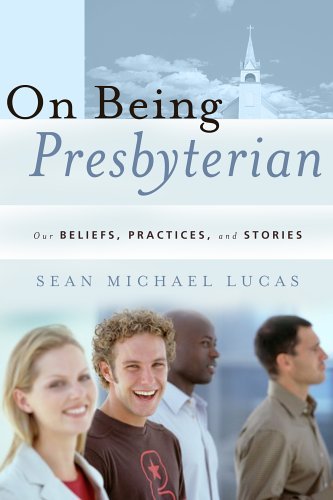
For those who might be interested, my copies of On Being Presbyterian arrived today from P&R.
I meant this book to be a lay-oriented introduction to Presbyterianism. As I wrote, I imagined that I was sitting across the table from someone at a Starbucks, trying to explain Presbyterian beliefs, practices, and stories to them. My hope was that the book would represent "vanilla Presbyterianism" in a winsome and warm way.
I am very thankful to my friends and colleauges who wrote gracious endorsements of the book. My real hope is that this book will be useful to churches in their new members and officers training classes and to prospective Presbyterians, who simply wish that someone would sit down with them and explain all this to them.
Saturday, May 20, 2006
What are the sacraments? No. 3
The Lord’s Supper: Strength for the Journey
Presbyterians, unlike Roman Catholics and other Christians, believe that there are only two sacraments of the New Testament: baptism and the Lord’s Supper (WCF 27:4). Having looked at baptism, let’s think about the Lord’s Supper. Most people who go to church know what this sacrament is, even when they call it something different like “the breaking of the bread,” “communion,” or “the Eucharist.” The name “Lord’s Supper” to name this sacrament comes from 1 Corinthians 11:20 and the heart of the ritual is common among all Christians: “the Lord’s Supper is a sacrament, wherein, by giving and receiving bread and wine, according to Christ’s appointment, his death is showed forth” (SC 96).
Typically, the mechanics of the Supper involves ordained ministers who “set apart the bread and win from common use, by the word of institution, thanksgiving and prayer; to take and break the bread, and to give both the bread and the wine to the communications; who are, by the same appointment, to take and eat the bread, and to drink the wine, in thankful remembrance that the body of Christ was broken and given, and his blood shed, for them” (LC 169).
While the validity of the sacrament is fairly easy to establish from Scripture, the sacrament’s efficacy is much more difficult to understand. In fact, at one point the Westminster Confession describes this Supper as a holy mystery (WCF 29:8). And because how the Supper “works” is a mystery, it has led to a number of disagreements about what happens in the Supper. Presbyterian confessional documents attempts to deal with a number of these “mistaken” views while setting forth our understanding of what happens in this meal. Sometimes the qualifications and caveats in the Standards are so confusing that it is hard to understand what is at stake or even what Presbyterians are trying to say. But if we are patient, I think we can get at a basic understanding of what happens in this holy mystery called the Lord’s Supper. What is important to understand is that Reformation debates over the Supper had everything to do with where Christ’s ascended body is and how believers feed upon that ascended body. We’ll see this as we go along.
Notice first that the confessional documents are very careful to tell us what does not happen in the Supper. One thing that doesn’t happen is that the bread and the wine do not actually, really, truly become Christ’s body and blood. This doctrine, called transubstantiation, is held by Roman Catholics. They believe that in the act of consecration by the priest (when he says in Latin, “this is my body”) that the bread, which is lifted up in the sight of the congregation for their adoration, actually and really becomes the substance of Christ’s body. The Westminster Confession spares no language in rejecting this position: this doctrine “is repugnant, not to Scripture alone, but even to common sense, and reason; [and it] overthrowth the nature of the sacrament, and hath been and is the cause of manifold superstitions; yea, of gross idolatries” (WCF 29:6). Presbyterians believe that when the bread and wine are consecrated by God through a minister’s prayer, “they till remain truly and only bread and wine, as they were before” (WCF 29:5). We also don’t believe that the Lord’s Supper provides an opportunity for Christ to be offered up to his Father once again in a real propitiation for sins. This “popish sacrifice of the mass (as they call it) is most abominably injurious to Christ’s one, only sacrifice, the alone propitiation for all the sins of His elect” (WCF 29:2).
Presbyterians also don’t believe that Christ’s body is somehow “in, with, or under the bread and wine” (WCF 29:7). This describes the Lutheran view, which is based on a belief that Christ’s resurrected and ascended body is “ubiquitous” (that is, everywhere at the same time). The result of the Lutheran view is that when an individual partakes of the bread in the Supper, the bread itself is not Christ’s body, but is accompanied by Christ’s body which surrounds it. Presbyterians don’t believe that Christ’s ascended body works like that. We believe that Christ’s resurrected body has ascended to heaven and sits at the right hand of God the Father. As a result, his body is not everywhere present at the same time to surround the bread and wine at the Supper.
So, what do Presbyterians believe happens in the Supper? How do we feed upon the body and blood of Christ? The Confession takes great pains to stress that we do not feed on Christ “corporally or carnally,” but “spiritually” and yet “really and indeed” (WCF 29:7). Perhaps you’ve read the somewhat tortured section of the Confession in 29:7:
How do these two things happen? Not corporally or carnally, but spiritually. In way perhaps we don’t always grasp intellectually, when we outwardly eat and drink the visible elements, we are inwardly feeding on Christ’s body and blood by faith. There is no change, no transformation, no surrounding of the bread and wine with Christ’s body. And yet, really and indeed, we feed on Christ’s body and blood spiritually.
John Calvin, the great sixteenth century Reformed pastor and theologian, believed that in the Supper the Holy Spirit worked to lift our hearts and minds to heaven, where Christ is seated at God the Father’s right hand, so that we might feed spiritually on his presence (Inst., 4.17.18). Yet Calvin was also careful to point out that our feeding upon Christ was a mystery that was felt, more than explained, because words themselves were inadequate to describe what is transacted in the Lord’s Supper (Inst., 4.17.7).
The upshot of all this is that in the Supper, we “receive and apply unto ourselves Christ crucified and all the benefits of his death” by faith (LC 170). The benefits that we receive are consequential to our living the Christian life well. We believe that in this meal we gain what is vital for “our spiritual nourishment and growth in grace,” including having our union and communion with Christ confirmed, our thankfulness to God and engagement to belong to him renewed, and our mutual love and fellowship with one another engaged (LC 168).
In order to receive these spiritual benefits, however, we must prepare ourselves before we come to the Lord’s Supper in at least two ways. First, we must examine ourselves. Drawing upon Paul’s injunction in 1 Corinthians 11:28, Presbyterians have long urged one another to examine themselves before they came to the Lord’s Table, seeking to ascertain “their being in Christ; their sins and wants; the truth and measure of their knowledge, faith, repentance, love to God and the brethren, charity to all men, forgiving those that have done them wrong; their desires after Christ; and their new obedience” (LC 171).
Second, we must seek to renew the exercise of all of our spiritual graces. As we consider and examine ourselves, we should meditate on the truths of God’s Word and on his great grace and forgiveness for those who fail in their spiritual duties. We also need to pray fervently, seeking God’s mercy and grace for our sins and failures and asking that he meet us in the Lord’s Supper to grant us his strengthening and nourishing grace in the meal.
During the Supper, we are called to wait upon God in the sacrament, observing diligently what is going on: the minister’s explanation of the sacrament, the words of institution, the invitation to the Supper, the prayer of consecration for the Supper, the breaking of bread and pouring out of wine, and the distribution of the elements. In the midst of these actions, we should seek to discern Christ’s body, believing that, in the bread and in the wine, Christ’s crucified body and blood are spiritually present to their faith and in these elements Christ and all his benefits are given to their faith. In thus discerning Christ’s body, we are stirred up to judge ourselves and sorrow for sin, to hunger and thirst after Christ, to feed upon him and receive of his fullness, trusting in his merits, rejoicing in his love, giving thanks for his grace, and to renew their covenant with God and with the other church members (LC 174). In many ways, the Lord’s Supper is the renewal of a solemn covenant between God and ourselves—we are forsaking our sin, resting on Christ and his merits for acceptance with God, and renewing new obedience to God and his Word in gratitude for his mercy. In response, God grants us all of Christ’s benefits, but more importantly he grants us Christ himself.
After the Supper, we should use some time to consider how we participated in the Supper. If we found spiritual comfort and renewal, then we should bless God for his mercy in the Supper, beg God for the continuance of this gracious renewal, watch against relapses into sin, and fulfill our spiritual duties. If we didn’t find that comfort and renewal, then we should think back to how we prepared ourselves beforehand for the Supper and how we carried ourselves during the Supper. If we were prepared for the Supper and sought God’s presence in the meal, then we wait for the spiritual benefit in God’s good time. But if we didn’t prepare well or if we didn’t carry ourselves well, then we should be humbled and seek God’s presence more fervently and diligently next time we have the opportunity to participate in the Lord’s Supper (LC 175).
Obviously, Presbyterians historically have taken the Lord’s Supper very seriously, perhaps more seriously than other evangelicals. That seriousness is reflected in the Presbyterian practice of “fencing the table.” In the eighteenth century, Scots and American Presbyterians were examineed by their ruling elders for their faith in Jesus Christ and current spiritual condition; if they were deemed to be “worthy professors,” these hardy souls were given “communion tokens” that would admit them to a place at the Lord’s table. In contemporary practice, Presbyterian ministers invite to come to the Supper those have made a profession of faith in a particular congregation and have been admitted to the table by either the local church session or some other authorized church leadership. We also warn those who have not made a profession of faith or who are living in unrepentant sin not to come to the table, so that they will not “eat and drink judgment to themselves” (SC 97; 1 Corinthians 11:27-32). In this way, Presbyterians have tried to preserve the purity of the Lord ’s Table.
Another way this seriousness is demonstrated is in the way in which we deal with our children in approaching the table. Perhaps the best way of getting at this point is to think through the similarities and differences between baptism and the Lord’s Supper. The similarities between the two are somewhat obvious (LC 176). We believe that God is the author of both baptism and the Lord’s Supper; they are both God’s idea and have his warrant. The focus of both is Christ and his benefits. Both are seals of the same covenant, the same promises. Each is to be done by ordained ministers of the gospel and by none other. And each is to be continued in the church until the end of the age. Some of the differences between the two are obvious as well, or at least, should be (LC 177). Baptism happens, or should happen, only once in a person’s life; the Lord’s Supper is to be administered often. Baptism uses water; the Supper uses bread and wine.
But other differences are more important. The Catechism says that baptism is a “sign and seal of our regeneration and ingrafting into Christ,” a grace that is conferred in God’s appointed time and that evidences itself in a full-hearted turn to Christ as Savior and Lord. The Lord’s Supper, on the other hand, is received those who have already begun the journey of faith, “to confirm our continuance and growth” in Jesus Christ. Or it could put it like this: baptism initiates our children into the visible people of God, into the church people, and into the care of the church and all the benefits that brings. Yet the Lord’s Supper has a different focus; it serves to confirm our faith and assure our hearts that as surely as we partake of bread and wine, so surely did Christ die for our sins.
As a result, Presbyterians believe that baptism is rightly administered “even to infants,” as we have just seen. Because our children belong to our households of faith, they should belong in a visible way to THE household of faith; and baptism initiates them into God’s visible people. However, we believe that the Supper is to be administered “only to such as are of years and ability to examine themselves.” The emphasis here is not upon adult-only communion but on professing believers-only communion. Our catechism presumes that infants or toddlers cannot examine themselves of “their being in Christ” (LC 172), that is, to recognize their sinfulness and turn to faith to Jesus Christ. When they come “of years and ability to examine themselves,” if they make a credible profession of faith in Jesus, then the local church’s session has the opportunity to admit them to the Lord’s table. As a result, the Presbyterians typically do not admit to the table children who have not made a profession of faith; not because they are children, but because faith in Jesus Christ is necessary for a worthy reception of the Supper.
Presbyterians, unlike Roman Catholics and other Christians, believe that there are only two sacraments of the New Testament: baptism and the Lord’s Supper (WCF 27:4). Having looked at baptism, let’s think about the Lord’s Supper. Most people who go to church know what this sacrament is, even when they call it something different like “the breaking of the bread,” “communion,” or “the Eucharist.” The name “Lord’s Supper” to name this sacrament comes from 1 Corinthians 11:20 and the heart of the ritual is common among all Christians: “the Lord’s Supper is a sacrament, wherein, by giving and receiving bread and wine, according to Christ’s appointment, his death is showed forth” (SC 96).
Typically, the mechanics of the Supper involves ordained ministers who “set apart the bread and win from common use, by the word of institution, thanksgiving and prayer; to take and break the bread, and to give both the bread and the wine to the communications; who are, by the same appointment, to take and eat the bread, and to drink the wine, in thankful remembrance that the body of Christ was broken and given, and his blood shed, for them” (LC 169).
While the validity of the sacrament is fairly easy to establish from Scripture, the sacrament’s efficacy is much more difficult to understand. In fact, at one point the Westminster Confession describes this Supper as a holy mystery (WCF 29:8). And because how the Supper “works” is a mystery, it has led to a number of disagreements about what happens in the Supper. Presbyterian confessional documents attempts to deal with a number of these “mistaken” views while setting forth our understanding of what happens in this meal. Sometimes the qualifications and caveats in the Standards are so confusing that it is hard to understand what is at stake or even what Presbyterians are trying to say. But if we are patient, I think we can get at a basic understanding of what happens in this holy mystery called the Lord’s Supper. What is important to understand is that Reformation debates over the Supper had everything to do with where Christ’s ascended body is and how believers feed upon that ascended body. We’ll see this as we go along.
Notice first that the confessional documents are very careful to tell us what does not happen in the Supper. One thing that doesn’t happen is that the bread and the wine do not actually, really, truly become Christ’s body and blood. This doctrine, called transubstantiation, is held by Roman Catholics. They believe that in the act of consecration by the priest (when he says in Latin, “this is my body”) that the bread, which is lifted up in the sight of the congregation for their adoration, actually and really becomes the substance of Christ’s body. The Westminster Confession spares no language in rejecting this position: this doctrine “is repugnant, not to Scripture alone, but even to common sense, and reason; [and it] overthrowth the nature of the sacrament, and hath been and is the cause of manifold superstitions; yea, of gross idolatries” (WCF 29:6). Presbyterians believe that when the bread and wine are consecrated by God through a minister’s prayer, “they till remain truly and only bread and wine, as they were before” (WCF 29:5). We also don’t believe that the Lord’s Supper provides an opportunity for Christ to be offered up to his Father once again in a real propitiation for sins. This “popish sacrifice of the mass (as they call it) is most abominably injurious to Christ’s one, only sacrifice, the alone propitiation for all the sins of His elect” (WCF 29:2).
Presbyterians also don’t believe that Christ’s body is somehow “in, with, or under the bread and wine” (WCF 29:7). This describes the Lutheran view, which is based on a belief that Christ’s resurrected and ascended body is “ubiquitous” (that is, everywhere at the same time). The result of the Lutheran view is that when an individual partakes of the bread in the Supper, the bread itself is not Christ’s body, but is accompanied by Christ’s body which surrounds it. Presbyterians don’t believe that Christ’s ascended body works like that. We believe that Christ’s resurrected body has ascended to heaven and sits at the right hand of God the Father. As a result, his body is not everywhere present at the same time to surround the bread and wine at the Supper.
So, what do Presbyterians believe happens in the Supper? How do we feed upon the body and blood of Christ? The Confession takes great pains to stress that we do not feed on Christ “corporally or carnally,” but “spiritually” and yet “really and indeed” (WCF 29:7). Perhaps you’ve read the somewhat tortured section of the Confession in 29:7:
Worthy receivers, outwardly partaking of the visible elements, in this sacrament, do then also, inwardly by faith, really and indeed, yet not carnally and corporally but spiritually, receive, and feed upon, Christ crucified, and all benefits of His death: the body and blood of Christ being then, not corporally or carnally, in, with, or under the bread and wine; yet, as really, but spiritually, present to the faith of believers in that ordinance, as the elements themselves are to their outward senses.Did you catch what the Confession is trying to say here? It says two important things: first, worthy receivers of the Supper receive and feed upon Christ crucified and all benefits of his death; and second, the body and blood of Christ are as surely present to the faith of believers in the Supper as the elements themselves are to their outward senses.
How do these two things happen? Not corporally or carnally, but spiritually. In way perhaps we don’t always grasp intellectually, when we outwardly eat and drink the visible elements, we are inwardly feeding on Christ’s body and blood by faith. There is no change, no transformation, no surrounding of the bread and wine with Christ’s body. And yet, really and indeed, we feed on Christ’s body and blood spiritually.
John Calvin, the great sixteenth century Reformed pastor and theologian, believed that in the Supper the Holy Spirit worked to lift our hearts and minds to heaven, where Christ is seated at God the Father’s right hand, so that we might feed spiritually on his presence (Inst., 4.17.18). Yet Calvin was also careful to point out that our feeding upon Christ was a mystery that was felt, more than explained, because words themselves were inadequate to describe what is transacted in the Lord’s Supper (Inst., 4.17.7).
The upshot of all this is that in the Supper, we “receive and apply unto ourselves Christ crucified and all the benefits of his death” by faith (LC 170). The benefits that we receive are consequential to our living the Christian life well. We believe that in this meal we gain what is vital for “our spiritual nourishment and growth in grace,” including having our union and communion with Christ confirmed, our thankfulness to God and engagement to belong to him renewed, and our mutual love and fellowship with one another engaged (LC 168).
In order to receive these spiritual benefits, however, we must prepare ourselves before we come to the Lord’s Supper in at least two ways. First, we must examine ourselves. Drawing upon Paul’s injunction in 1 Corinthians 11:28, Presbyterians have long urged one another to examine themselves before they came to the Lord’s Table, seeking to ascertain “their being in Christ; their sins and wants; the truth and measure of their knowledge, faith, repentance, love to God and the brethren, charity to all men, forgiving those that have done them wrong; their desires after Christ; and their new obedience” (LC 171).
Second, we must seek to renew the exercise of all of our spiritual graces. As we consider and examine ourselves, we should meditate on the truths of God’s Word and on his great grace and forgiveness for those who fail in their spiritual duties. We also need to pray fervently, seeking God’s mercy and grace for our sins and failures and asking that he meet us in the Lord’s Supper to grant us his strengthening and nourishing grace in the meal.
During the Supper, we are called to wait upon God in the sacrament, observing diligently what is going on: the minister’s explanation of the sacrament, the words of institution, the invitation to the Supper, the prayer of consecration for the Supper, the breaking of bread and pouring out of wine, and the distribution of the elements. In the midst of these actions, we should seek to discern Christ’s body, believing that, in the bread and in the wine, Christ’s crucified body and blood are spiritually present to their faith and in these elements Christ and all his benefits are given to their faith. In thus discerning Christ’s body, we are stirred up to judge ourselves and sorrow for sin, to hunger and thirst after Christ, to feed upon him and receive of his fullness, trusting in his merits, rejoicing in his love, giving thanks for his grace, and to renew their covenant with God and with the other church members (LC 174). In many ways, the Lord’s Supper is the renewal of a solemn covenant between God and ourselves—we are forsaking our sin, resting on Christ and his merits for acceptance with God, and renewing new obedience to God and his Word in gratitude for his mercy. In response, God grants us all of Christ’s benefits, but more importantly he grants us Christ himself.
After the Supper, we should use some time to consider how we participated in the Supper. If we found spiritual comfort and renewal, then we should bless God for his mercy in the Supper, beg God for the continuance of this gracious renewal, watch against relapses into sin, and fulfill our spiritual duties. If we didn’t find that comfort and renewal, then we should think back to how we prepared ourselves beforehand for the Supper and how we carried ourselves during the Supper. If we were prepared for the Supper and sought God’s presence in the meal, then we wait for the spiritual benefit in God’s good time. But if we didn’t prepare well or if we didn’t carry ourselves well, then we should be humbled and seek God’s presence more fervently and diligently next time we have the opportunity to participate in the Lord’s Supper (LC 175).
Obviously, Presbyterians historically have taken the Lord’s Supper very seriously, perhaps more seriously than other evangelicals. That seriousness is reflected in the Presbyterian practice of “fencing the table.” In the eighteenth century, Scots and American Presbyterians were examineed by their ruling elders for their faith in Jesus Christ and current spiritual condition; if they were deemed to be “worthy professors,” these hardy souls were given “communion tokens” that would admit them to a place at the Lord’s table. In contemporary practice, Presbyterian ministers invite to come to the Supper those have made a profession of faith in a particular congregation and have been admitted to the table by either the local church session or some other authorized church leadership. We also warn those who have not made a profession of faith or who are living in unrepentant sin not to come to the table, so that they will not “eat and drink judgment to themselves” (SC 97; 1 Corinthians 11:27-32). In this way, Presbyterians have tried to preserve the purity of the Lord ’s Table.
Another way this seriousness is demonstrated is in the way in which we deal with our children in approaching the table. Perhaps the best way of getting at this point is to think through the similarities and differences between baptism and the Lord’s Supper. The similarities between the two are somewhat obvious (LC 176). We believe that God is the author of both baptism and the Lord’s Supper; they are both God’s idea and have his warrant. The focus of both is Christ and his benefits. Both are seals of the same covenant, the same promises. Each is to be done by ordained ministers of the gospel and by none other. And each is to be continued in the church until the end of the age. Some of the differences between the two are obvious as well, or at least, should be (LC 177). Baptism happens, or should happen, only once in a person’s life; the Lord’s Supper is to be administered often. Baptism uses water; the Supper uses bread and wine.
But other differences are more important. The Catechism says that baptism is a “sign and seal of our regeneration and ingrafting into Christ,” a grace that is conferred in God’s appointed time and that evidences itself in a full-hearted turn to Christ as Savior and Lord. The Lord’s Supper, on the other hand, is received those who have already begun the journey of faith, “to confirm our continuance and growth” in Jesus Christ. Or it could put it like this: baptism initiates our children into the visible people of God, into the church people, and into the care of the church and all the benefits that brings. Yet the Lord’s Supper has a different focus; it serves to confirm our faith and assure our hearts that as surely as we partake of bread and wine, so surely did Christ die for our sins.
As a result, Presbyterians believe that baptism is rightly administered “even to infants,” as we have just seen. Because our children belong to our households of faith, they should belong in a visible way to THE household of faith; and baptism initiates them into God’s visible people. However, we believe that the Supper is to be administered “only to such as are of years and ability to examine themselves.” The emphasis here is not upon adult-only communion but on professing believers-only communion. Our catechism presumes that infants or toddlers cannot examine themselves of “their being in Christ” (LC 172), that is, to recognize their sinfulness and turn to faith to Jesus Christ. When they come “of years and ability to examine themselves,” if they make a credible profession of faith in Jesus, then the local church’s session has the opportunity to admit them to the Lord’s table. As a result, the Presbyterians typically do not admit to the table children who have not made a profession of faith; not because they are children, but because faith in Jesus Christ is necessary for a worthy reception of the Supper.
Friday, May 19, 2006
Heroes
Driving in to work today, the sports radio guys on 1380 ESPN were debating whether Albert Pujols is starting to become "over-hyped." This week, for example, Albert is on the covers of both the Sporting News and Sports Illustrated; and Bernie Miklasz, the radio host and columnist for the St. Louis Post-Dispatch, related that the newspaper will be preparing a special Pujols section for a Sunday edition in June.
In the midst of the conversation, one of the talking heads observed that this is always what the media does--seize on a single individual and hype them to gigantic proportions. The local media did that with Mark McGwire in the late 1990s and they are doing it again with Pujols. And the reason they are doing it is that this sort of thing sells papers.
But why does it sell papers? Or for that matter, why do legions of Cardinals fans show up to the ballgames with Pujols jerseys (or Rolen, Edmonds, and Carpenter jerseys--I have a Rolen one myself)? No one asked or answered the question, but I think it gets down to the most basic matter of the heart. Human beings are wired to look for heroes.
And yet, all our heroes disappoint in the end. One clear example of that was McGwire himself, who has a section of local highway named after him because he broke Roger Maris' home run record. When he sat at the congressional hearing on steriods in March 2005 and let down his fans and supports with a lawyer-fed answer to the questions posted him, many people turned on him with a viciousness that speaks to broken hearts and shattered hopes. Even Miklasz, this morning, declared his vow passionately never to be taken in by an athlete in the same way as McGwire. It was less the objective voice of a journalist and more the bruised and violated voice of a erstwhile believer.
It all made me think of my favorite Steve Taylor song, "Hero":
When our heroes break our hearts, our response should not merely be the anger of betrayal. Nor is the answer to swear off looking for heroes; that is an impossibility, because we are wired to "look up" to others, to search for models and patterns, to cherish dreams and aspirations inculcated by others. Rather, we must come to the realization that all our human heroes, as flawed as they are, even biblical heroes or historical heroes, are meant to point us to the only one who is truly heroic, the only one who does not, cannot disappoint us, the only one who has truly done things that have never been seen before, Jesus himself.
In the midst of the conversation, one of the talking heads observed that this is always what the media does--seize on a single individual and hype them to gigantic proportions. The local media did that with Mark McGwire in the late 1990s and they are doing it again with Pujols. And the reason they are doing it is that this sort of thing sells papers.
But why does it sell papers? Or for that matter, why do legions of Cardinals fans show up to the ballgames with Pujols jerseys (or Rolen, Edmonds, and Carpenter jerseys--I have a Rolen one myself)? No one asked or answered the question, but I think it gets down to the most basic matter of the heart. Human beings are wired to look for heroes.
And yet, all our heroes disappoint in the end. One clear example of that was McGwire himself, who has a section of local highway named after him because he broke Roger Maris' home run record. When he sat at the congressional hearing on steriods in March 2005 and let down his fans and supports with a lawyer-fed answer to the questions posted him, many people turned on him with a viciousness that speaks to broken hearts and shattered hopes. Even Miklasz, this morning, declared his vow passionately never to be taken in by an athlete in the same way as McGwire. It was less the objective voice of a journalist and more the bruised and violated voice of a erstwhile believer.
It all made me think of my favorite Steve Taylor song, "Hero":
When the house fell asleep
there was always a light
and it fell from the page to
the eyes of an American boy.
In a storybook land
I could dream what I read when
it went to my head I'd see
I wanna be a hero
chorus:
Hero it's a nice-boy notion
that the real world's gonna destroy
you know it's a Marvel comicbook Saturday matinee fairytale, boy
Growing older you'll find
that illusions are brought
and the idol you thought you'd be
was just another zero
I wanna be a hero
Heroes died when the squealers bought 'em off
died when the dealers got 'em off
welcome to the "in it for the money as an idol" show
when they ain't as big as life
when they ditch their second wife
where's the boy to go? gotta be a hero
When our heroes break our hearts, our response should not merely be the anger of betrayal. Nor is the answer to swear off looking for heroes; that is an impossibility, because we are wired to "look up" to others, to search for models and patterns, to cherish dreams and aspirations inculcated by others. Rather, we must come to the realization that all our human heroes, as flawed as they are, even biblical heroes or historical heroes, are meant to point us to the only one who is truly heroic, the only one who does not, cannot disappoint us, the only one who has truly done things that have never been seen before, Jesus himself.
When the house fell asleep
from a book I was led
to a light that I never knew
I wanna be your hero
and he spoke to my heart
from the moment I prayed
here's a pattern I made for you
I wanna be your hero
What are the sacraments? No. 2
Baptism: Entrance into God’s Visible People
Though some may believe that Presbyterians’ understanding of baptism is somewhat complex, it actually is rooted in the larger story of what God is doing in this world through his people. The sign of baptism is rooted in God’s larger unchanging purpose in human history. From the very beginning, God has been redeeming a people for his own possession for his own glory. While God certainly calls individuals, from the very beginning, he has especially emphasized the relationship of federal heads and their households and their place within his larger and unchanging purpose of redemption. Thus, human history began with Adam and his household; with Abel and Cain and their households; and particularly, with Abraham and his household.
God made a covenant with Abraham, promising “to be God to you and to your offspring after you” (Genesis 17:7). And in order to seal that promise, God gave Abraham a sign—circumcision, which was to be administered to Abraham and to all the males in his household. This sign was a promise, a reminder, and a community marker that always went with Jewish males that God had promised to be God to them. Circumcision also served as the initiatory rite into the body of those who profess to be God’s people. The content of the promise that God made to Abraham—"to be God to you and your offspring after you"—remained the same throughout the Old Testament. Each father was charged with instructing his household in the meaning of circumcision—the need to have one’s heart circumcised by God, the need to claim the covenant promises by faith in the coming Redeemer of God’s elect and to repent of sins.
In the New Testament, the Apostle Peter makes plain that the content of God’s promise has not changed—God promises to be a God to us and our households (Acts 2:38-39). What changed was the form and subjects: whereas in the Old Testament, circumcision was applied to males in the household, in the New Testament baptism was applied to all who profess faith in the Redeemer of God’s people as well as their households. For example, in Acts 16, household heads Lydia and the Philippian jailer believe and their entire households are baptized. The reason such household baptisms were appropriate was this household logic that was operative in the Old Testament is still in operation in the New. Our children are set apart (“holy”) in God’s sight because we as household heads profess faith in God (1 Corinthians 7:14); as a result, it is right to extend to them the sign that they belong to God’s visible people. This sign seals God’s promise to our children, reminds our children of God’s promise, and marks them off from the world as belonging to God.
In this New Testament era, as household heads, we are called to instruct our children in the meaning of their baptism, to urge them to embrace God’s promise in Jesus Christ by repenting of their sins and professing faith in him, and to improve their baptism at every opportunity. And God’s work of redemption is extended when God’s purpose in our households is fulfilled—when the children of the household leave their father’s house and establish their own households, professing repentance and faith, embracing Jesus Christ to whom the signs pointed, dedicated to raising godly offspring for God’s glory.
This understanding of baptism is rooted in a particular understanding of the church as a visible people. Presbyterians believe that the visible church is made up of professing believers and their children. In other words, the ideal of a “regenerate church membership” is an unbiblical ideal because it makes too direct a connection between the visible people of God and the body of those God has chosen from the beginning to the end of time. Those who are in charge of admitting people to the Lord’s Supper have no way of ascertaining who is regenerate and who is not. All we have are individuals’ professions of faith. Now, elders do their best to investigate those professions of faith, to insure that they are credible and sincere. And we do believe, in a judgment of charity, that these professions of faith are genuine and represent a true spirituality reality. Still, that is a long way from saying that the visible church’s membership is to be restricted to those only whom we deem to be truly elect and genuinely regenerate.
Once our view of who makes up the visible church shifts, our understanding of baptism as a sign of initiation into the visible church shifts as well. Suddenly, baptism moves from being our act of testifying that we are following Jesus in obedience to God’s act of initiating us into the visible people of God. As a result, it is properly administered to those who are making professions of faith as well as their children, because God’s promise is offered to both us and our children (Acts 2:39).
Though some may believe that Presbyterians’ understanding of baptism is somewhat complex, it actually is rooted in the larger story of what God is doing in this world through his people. The sign of baptism is rooted in God’s larger unchanging purpose in human history. From the very beginning, God has been redeeming a people for his own possession for his own glory. While God certainly calls individuals, from the very beginning, he has especially emphasized the relationship of federal heads and their households and their place within his larger and unchanging purpose of redemption. Thus, human history began with Adam and his household; with Abel and Cain and their households; and particularly, with Abraham and his household.
God made a covenant with Abraham, promising “to be God to you and to your offspring after you” (Genesis 17:7). And in order to seal that promise, God gave Abraham a sign—circumcision, which was to be administered to Abraham and to all the males in his household. This sign was a promise, a reminder, and a community marker that always went with Jewish males that God had promised to be God to them. Circumcision also served as the initiatory rite into the body of those who profess to be God’s people. The content of the promise that God made to Abraham—"to be God to you and your offspring after you"—remained the same throughout the Old Testament. Each father was charged with instructing his household in the meaning of circumcision—the need to have one’s heart circumcised by God, the need to claim the covenant promises by faith in the coming Redeemer of God’s elect and to repent of sins.
In the New Testament, the Apostle Peter makes plain that the content of God’s promise has not changed—God promises to be a God to us and our households (Acts 2:38-39). What changed was the form and subjects: whereas in the Old Testament, circumcision was applied to males in the household, in the New Testament baptism was applied to all who profess faith in the Redeemer of God’s people as well as their households. For example, in Acts 16, household heads Lydia and the Philippian jailer believe and their entire households are baptized. The reason such household baptisms were appropriate was this household logic that was operative in the Old Testament is still in operation in the New. Our children are set apart (“holy”) in God’s sight because we as household heads profess faith in God (1 Corinthians 7:14); as a result, it is right to extend to them the sign that they belong to God’s visible people. This sign seals God’s promise to our children, reminds our children of God’s promise, and marks them off from the world as belonging to God.
In this New Testament era, as household heads, we are called to instruct our children in the meaning of their baptism, to urge them to embrace God’s promise in Jesus Christ by repenting of their sins and professing faith in him, and to improve their baptism at every opportunity. And God’s work of redemption is extended when God’s purpose in our households is fulfilled—when the children of the household leave their father’s house and establish their own households, professing repentance and faith, embracing Jesus Christ to whom the signs pointed, dedicated to raising godly offspring for God’s glory.
This understanding of baptism is rooted in a particular understanding of the church as a visible people. Presbyterians believe that the visible church is made up of professing believers and their children. In other words, the ideal of a “regenerate church membership” is an unbiblical ideal because it makes too direct a connection between the visible people of God and the body of those God has chosen from the beginning to the end of time. Those who are in charge of admitting people to the Lord’s Supper have no way of ascertaining who is regenerate and who is not. All we have are individuals’ professions of faith. Now, elders do their best to investigate those professions of faith, to insure that they are credible and sincere. And we do believe, in a judgment of charity, that these professions of faith are genuine and represent a true spirituality reality. Still, that is a long way from saying that the visible church’s membership is to be restricted to those only whom we deem to be truly elect and genuinely regenerate.
Once our view of who makes up the visible church shifts, our understanding of baptism as a sign of initiation into the visible church shifts as well. Suddenly, baptism moves from being our act of testifying that we are following Jesus in obedience to God’s act of initiating us into the visible people of God. As a result, it is properly administered to those who are making professions of faith as well as their children, because God’s promise is offered to both us and our children (Acts 2:39).
Thursday, May 18, 2006
What are the sacraments? No. 1
[Note: although On Being Presbyterian is supposed to be shipped this week, I've had my students reading a page proof copy--they had two essay questions on their final exam that required them to reflect on issues in the book. One of the pleasing comments that has come up has centered on the helpfulness of the sacraments chapter. I hope that it is helpful and represents a "vanilla Presbyterian" position that has an eye toward the mainstream Reformed and Westminster tradition.]
Perhaps the greatest intellectual hurdle for many people who have backgrounds in broader evangelicalism to overcome are Presbyterian beliefs about the sacraments of baptism and the Lord’s Supper. For these sisters and brothers, when you say the word “sacrament,” their minds immediately think about the Roman Catholic Church, which builds its entire religious life structure around seven sacraments, providing “grace” for individuals from birth to death.
Or perhaps these friends have come to Christ from more formal church backgrounds, joined evangelical churches, and have been convinced that they needed to be “re-baptized” because they were told that their infant baptisms weren’t legitimate since they weren’t preceded by a profession of faith. Due to the influence of common sense readings of Scripture and a general reticence against believing that sacraments can serve as means of grace in any sense, many struggle with the Presbyterian understanding of how baptism and the Lord’s Supper operate as means of grace in the Christian life.
What is a Sacrament?
Presbyterians, along with many other believers who think sacramentally, would say that a sacrament is a “holy sign and seal of the covenant of grace” (WCF 27:1). In other words, a sacrament pictures or signs God’s promises. In biblical usage a “sign” is like a big road sign with an arrow pointing you to Jesus Christ. This is how, for example, the word is used in John’s Gospel: “This, the first of his signs, Jesus did at Cana in Galilee, and manifested his glory” (John 2:11). The sign was meant to point the disciples (and John’s readers) to Jesus as God’s promised Messiah. It is the same way with a sacrament—baptism and the Lord’s Supper are like big road signs that point you to Jesus.
A sacrament also seals God’s promise. In older times, documents would bear a mark from the author of the letter or treaty that sealed the material contained in it. In our day, we talk about the “Good Housekeeping Seal of Approval”; when you see that seal, you know that Good Housekeeping has tested the product and approved it. A seal gives you confidence that the product or the letter is what it purports to be. In the same way, a sacrament seals God’s promises and gives you confidence that God’s promises can be trusted. It is a type of guarantee—if you trust God and claim his promises signed for you in the sacraments, you can be assured that God will keep his sealed promise to you. As the Westminster Confession puts it, sacraments “confirm our interest in him” (WCF 27:1). They give us assurance or confidence as they confirm our interest in God and his promises.
Sacraments also do something else. They “put a visible difference between those that belong unto the Church and the rest of the world” (WCF 27:1). They mark us as different from the world, as being on a different team, if you will. That’s why I like to say that baptism is like a jersey that marks us as part of the baptized team. It identifies us and our children as members of the visible church, those who have been baptized and who profess faith in the triune God. In a similar fashion, the Lord’s Supper marks off those who have made a good profession in Jesus Christ from the rest of the world that has not. It serves as a picture of those who will participate in the final “marriage supper of the Lamb” (Revelation 19:6-11), those who will be part of the new heavens and new earth.
How do sacraments do these things? Well, there is no power in the sacrament itself that causes God’s grace to come to an individual in order to confirm our interest in him or “to engage him to the service of God in Christ” (WCF 27:1, 3). Instead, the sacraments serve as signs for a spiritual reality, namely Christ and his benefits. And there is a “sacramental union,” or a “spiritual relation” between the sign and the spiritual reality. That’s why when we distribute the Lord’s Supper, the minister will often say, “This is the body of Christ. Take and eat.” Presbyterians don’t believe that the bread in the Lord’s Supper is actually transformed into Christ’s body, nor that the bread has Christ’s body “in, with, or under” the bread. Rather, we believe that there is a spiritual relationship between Christ’s ascended and glorified body and the bread by which we are enabled by God’s grace and his Spirit to feed upon Christ’s presence and receive his benefits. It is because of this sacramental union between the sign and the thing signified that “the names and effects of the one are attributed to the other” (WCF 27:2).
In thinking about how sacraments “work,” I think it is very important to distinguish the validity of a sacrament from its efficacy. A sacrament is valid, that is we have warrant for these sacraments, because it is based on God’s command and promise, contained in the word of institution. But a sacrament is efficacious, it “works” if you will, because the Spirit applies Christ and his benefits to the individual who responses in faith to the promise.
And so with baptism, we could say that the validity of the sacrament of baptism—for professing adults as well as their children—is rooted in God’s promise. In baptism, God promises certain benefits—“his ingrafting into Christ, of his regeneration, of remission of sins”—that obligates the individual “to walk in newness of life” (WCF 28:1). The promise is valid because God promises it, not because the individual testifies to some new spiritual reality in themselves. However, the efficacy of baptism is tied to the choosing purposes of God, the work of the Holy Spirit, and the response of faith by the individual. The grace that baptism signs and seals—that baptism exhibits and confers (WCF 28:6)—is not tied to the moment of administration nor is it given to everyone to whom baptism is administered (WCF 28:5). Instead, grace is given by the Holy Spirit to those whom God the King has chosen in his appointed time (WCF 28:6).
This distinction between the validity and efficacy of a sacrament is important because other evangelicals fail to recognize this distinction and so misunderstand what happens in baptism and the Lord’s Supper. For example, those who reject infant baptism do so because they presume that baptism is only valid when it is efficacious. That is, they believe that the only “biblical” baptism is one in which the individual by her own profession of faith at the moment of administration receives the grace offered in baptism. Others who have a very high view of infant baptism ironically make the same mistake—they believe that something must “happen” at the moment of baptism and so they argue that a child’s faith is awakened at baptism so that they grasp the promise of God’s Word and so receive grace. Or they presume that the child is regenerate and so baptize based on the presumption that God’s grace has already been at work.
But both of these approaches confuse the sacrament’s validity with its efficacy. A baptism is valid when it proclaims the promise of God by an ordained minister using the Trinitarian and biblical formula. It is efficacious, it confers grace, when God’s Spirit creates faith in the individual so that they grasp God’s promise by faith and so fill full the meaning of the sign whenever that may be.
One other thing to consider when we think about sacraments is that there was Old Testament as well as New Testament sacraments. The Old Testament sacraments were circumcision and Passover while the New Testament sacraments are baptism and the Lord’s Supper. Presbyterians believe that “in regard of the spiritual things thereby signified and exhibited” the Old and New Testament sacraments signified for substance the same things (WCF 27:5). That is, circumcision and the Passover both pointed to God’s promise of Christ and his benefits; baptism and the Supper do as well.
This continuity in terms of the substance of the things signified is very important—it means that there are not two stories, two religions, in the Bible, but one story and one “religion” in which God demands the worship of his people and they respond to him in faith. But the discontinuity is important as well—the forms were changed, the terms of admittance were changed, the rules and regulations were changed. That means we can’t simply draw a straight line between circumcision and baptism or Passover and Supper; rather, we must be sensitive to the way the risen Christ transforms these signs and seals. There are connections between the Old and New Testament sacraments (Colossians 2:11-12; 1 Corinthians 5:7, 10:1-4, 11:23-28), but there are differences as well. It is important to bear these similarities and differences in mind.
Perhaps the greatest intellectual hurdle for many people who have backgrounds in broader evangelicalism to overcome are Presbyterian beliefs about the sacraments of baptism and the Lord’s Supper. For these sisters and brothers, when you say the word “sacrament,” their minds immediately think about the Roman Catholic Church, which builds its entire religious life structure around seven sacraments, providing “grace” for individuals from birth to death.
Or perhaps these friends have come to Christ from more formal church backgrounds, joined evangelical churches, and have been convinced that they needed to be “re-baptized” because they were told that their infant baptisms weren’t legitimate since they weren’t preceded by a profession of faith. Due to the influence of common sense readings of Scripture and a general reticence against believing that sacraments can serve as means of grace in any sense, many struggle with the Presbyterian understanding of how baptism and the Lord’s Supper operate as means of grace in the Christian life.
What is a Sacrament?
Presbyterians, along with many other believers who think sacramentally, would say that a sacrament is a “holy sign and seal of the covenant of grace” (WCF 27:1). In other words, a sacrament pictures or signs God’s promises. In biblical usage a “sign” is like a big road sign with an arrow pointing you to Jesus Christ. This is how, for example, the word is used in John’s Gospel: “This, the first of his signs, Jesus did at Cana in Galilee, and manifested his glory” (John 2:11). The sign was meant to point the disciples (and John’s readers) to Jesus as God’s promised Messiah. It is the same way with a sacrament—baptism and the Lord’s Supper are like big road signs that point you to Jesus.
A sacrament also seals God’s promise. In older times, documents would bear a mark from the author of the letter or treaty that sealed the material contained in it. In our day, we talk about the “Good Housekeeping Seal of Approval”; when you see that seal, you know that Good Housekeeping has tested the product and approved it. A seal gives you confidence that the product or the letter is what it purports to be. In the same way, a sacrament seals God’s promises and gives you confidence that God’s promises can be trusted. It is a type of guarantee—if you trust God and claim his promises signed for you in the sacraments, you can be assured that God will keep his sealed promise to you. As the Westminster Confession puts it, sacraments “confirm our interest in him” (WCF 27:1). They give us assurance or confidence as they confirm our interest in God and his promises.
Sacraments also do something else. They “put a visible difference between those that belong unto the Church and the rest of the world” (WCF 27:1). They mark us as different from the world, as being on a different team, if you will. That’s why I like to say that baptism is like a jersey that marks us as part of the baptized team. It identifies us and our children as members of the visible church, those who have been baptized and who profess faith in the triune God. In a similar fashion, the Lord’s Supper marks off those who have made a good profession in Jesus Christ from the rest of the world that has not. It serves as a picture of those who will participate in the final “marriage supper of the Lamb” (Revelation 19:6-11), those who will be part of the new heavens and new earth.
How do sacraments do these things? Well, there is no power in the sacrament itself that causes God’s grace to come to an individual in order to confirm our interest in him or “to engage him to the service of God in Christ” (WCF 27:1, 3). Instead, the sacraments serve as signs for a spiritual reality, namely Christ and his benefits. And there is a “sacramental union,” or a “spiritual relation” between the sign and the spiritual reality. That’s why when we distribute the Lord’s Supper, the minister will often say, “This is the body of Christ. Take and eat.” Presbyterians don’t believe that the bread in the Lord’s Supper is actually transformed into Christ’s body, nor that the bread has Christ’s body “in, with, or under” the bread. Rather, we believe that there is a spiritual relationship between Christ’s ascended and glorified body and the bread by which we are enabled by God’s grace and his Spirit to feed upon Christ’s presence and receive his benefits. It is because of this sacramental union between the sign and the thing signified that “the names and effects of the one are attributed to the other” (WCF 27:2).
In thinking about how sacraments “work,” I think it is very important to distinguish the validity of a sacrament from its efficacy. A sacrament is valid, that is we have warrant for these sacraments, because it is based on God’s command and promise, contained in the word of institution. But a sacrament is efficacious, it “works” if you will, because the Spirit applies Christ and his benefits to the individual who responses in faith to the promise.
And so with baptism, we could say that the validity of the sacrament of baptism—for professing adults as well as their children—is rooted in God’s promise. In baptism, God promises certain benefits—“his ingrafting into Christ, of his regeneration, of remission of sins”—that obligates the individual “to walk in newness of life” (WCF 28:1). The promise is valid because God promises it, not because the individual testifies to some new spiritual reality in themselves. However, the efficacy of baptism is tied to the choosing purposes of God, the work of the Holy Spirit, and the response of faith by the individual. The grace that baptism signs and seals—that baptism exhibits and confers (WCF 28:6)—is not tied to the moment of administration nor is it given to everyone to whom baptism is administered (WCF 28:5). Instead, grace is given by the Holy Spirit to those whom God the King has chosen in his appointed time (WCF 28:6).
This distinction between the validity and efficacy of a sacrament is important because other evangelicals fail to recognize this distinction and so misunderstand what happens in baptism and the Lord’s Supper. For example, those who reject infant baptism do so because they presume that baptism is only valid when it is efficacious. That is, they believe that the only “biblical” baptism is one in which the individual by her own profession of faith at the moment of administration receives the grace offered in baptism. Others who have a very high view of infant baptism ironically make the same mistake—they believe that something must “happen” at the moment of baptism and so they argue that a child’s faith is awakened at baptism so that they grasp the promise of God’s Word and so receive grace. Or they presume that the child is regenerate and so baptize based on the presumption that God’s grace has already been at work.
But both of these approaches confuse the sacrament’s validity with its efficacy. A baptism is valid when it proclaims the promise of God by an ordained minister using the Trinitarian and biblical formula. It is efficacious, it confers grace, when God’s Spirit creates faith in the individual so that they grasp God’s promise by faith and so fill full the meaning of the sign whenever that may be.
One other thing to consider when we think about sacraments is that there was Old Testament as well as New Testament sacraments. The Old Testament sacraments were circumcision and Passover while the New Testament sacraments are baptism and the Lord’s Supper. Presbyterians believe that “in regard of the spiritual things thereby signified and exhibited” the Old and New Testament sacraments signified for substance the same things (WCF 27:5). That is, circumcision and the Passover both pointed to God’s promise of Christ and his benefits; baptism and the Supper do as well.
This continuity in terms of the substance of the things signified is very important—it means that there are not two stories, two religions, in the Bible, but one story and one “religion” in which God demands the worship of his people and they respond to him in faith. But the discontinuity is important as well—the forms were changed, the terms of admittance were changed, the rules and regulations were changed. That means we can’t simply draw a straight line between circumcision and baptism or Passover and Supper; rather, we must be sensitive to the way the risen Christ transforms these signs and seals. There are connections between the Old and New Testament sacraments (Colossians 2:11-12; 1 Corinthians 5:7, 10:1-4, 11:23-28), but there are differences as well. It is important to bear these similarities and differences in mind.
Wednesday, May 17, 2006
Da Vinci Decoded
I have a confession to make: my contrarian nature causes me to boycott popular cultural phenomenon. When I was a kid, I refused to see both "Top Gun" and "Dirty Dancing" (still haven't seen 'em either). I still haven't sat through "Titantic." Even when "The Passion of the Christ" was the hot movie, I missed that as well (though I had more biblical, than contrarian reasons for missing that).
Which is all too say, I'll probably miss out on "The Da Vinci Code" movie, although I am tempted to read the novel. It appears that the entire evangelical world is trying to captilize on the movie, either for evangelism or apologetics. I won't miss not reading those books.
But one of the simplest and free explanations, as well as one of the best, about the errors of Dan Brown's novel is Phil Ryken's. I recommend it very highly as a thoughtful, Christian response.
Which is all too say, I'll probably miss out on "The Da Vinci Code" movie, although I am tempted to read the novel. It appears that the entire evangelical world is trying to captilize on the movie, either for evangelism or apologetics. I won't miss not reading those books.
But one of the simplest and free explanations, as well as one of the best, about the errors of Dan Brown's novel is Phil Ryken's. I recommend it very highly as a thoughtful, Christian response.
Presbyterians Together, No. 4
Okay, this isn't a real post. I simply want to direct you to Phil Ryken's excellent post on the Presbyterians Together document.
Tuesday, May 16, 2006
Presbyterians Together, No. 3
One more point on this whole matter. There has been some sort of confusion by friends of the Presbyterians Together document on why some have been claiming that the place to settle doctrinal issues is in the courts of the church. On more than blog I have read the claim that the church's courts are a last resort for those who can't resolve their issues peaceably.
But this claim betrays a lack of understanding of the basic principles of Presbyterian polity. One of the key principles of that polity is this: I, as an individual minister, have no authority to declare doctrine on my own. Rather, it is only as the church is gathered in its "courts" is there any authority to exercise "judgment," which includes not only discipline, but also the duty of declaring doctrine.
This is what the PCA Book of Church Order covers in chapter 3, "The nature and extent of church power (or authority)." The BCO makes the point that ecclesiastical authority is exercised in two ways: there is the power of order, which is exercised "severally" (or individually) under a grant from presbytery; the power of order covers things such as preaching the Gospel, administering the sacraments, and exercising pastoral care. And there is the power of juridiction, which is only exercised jointly as church courts (BCO 3-2) and covers matters such as doctrine and discipline (BCO 13-9, 14-6). In both instances, I only have authority as a minister as it is granted or exercised with other presbyters who exercise oversight over a larger part of Christ's church.
This is why when candidates for ministry apply for membership in our presbyteries, they appeal to the presbytery allow their scruples of conscience in reference to the Westminster Standards. Presbyteries have the authority to determine whether such scruples conflict with the Standards (BCO 21-4). As a private individual or as a single minister, I have no authority to determine that on my own for my brothers. We must hear the presbytery's voice on the matter as they rule "jointly" as a church court.
And so, far from being a "last resort," the church's courts should be the first place we go when we begin to raise biblical or theological issues that appear to raise questions about a church's consensus on certain doctrinal matters. This is the case for two reasons: we can't trust our own understandings on these matters for we may be self-deceived; and we must hear the voice of the church on matters of doctrine and discipline.
After hearing the church's voice, it may be that our consciences are convinced that the Word of God teaches a contrary position to the declared doctrinal position of the church; and if so, then we have to determine one of three actions: whether we will seek to change the church's consensus by working to see the church amend its doctrinal standard; whether we will submit to the brothers; or whether we will follow our consciences into a different church communion.
Whatever may be the case, we must begin to deal with these issues in a Presbyterian fashion. And that means we must demonstrate our commitment to love for our brothers by bringing these issues to the notice of the larger church in ways appropriate to our polity. And it also means that we need to forsake our understanding of the church's courts that appears to be drawn from American jurisprudence (i.e., as litigious bodies of punishment) and view them instead as the place where God's Spirit dwells to guide the entire church in matters of "judgment," which include the weighty doctrinal matters under discussion today.
[BTW--the best single source for understanding Presbyterian polity remains James Bannerman's The Church of Christ. While you may find the two-volume Banner of Truth version on the used book market, it is currently only available in a paperback version published by Westminster Discount Books and you can buy it at Westminster Seminary Bookstore.]
But this claim betrays a lack of understanding of the basic principles of Presbyterian polity. One of the key principles of that polity is this: I, as an individual minister, have no authority to declare doctrine on my own. Rather, it is only as the church is gathered in its "courts" is there any authority to exercise "judgment," which includes not only discipline, but also the duty of declaring doctrine.
This is what the PCA Book of Church Order covers in chapter 3, "The nature and extent of church power (or authority)." The BCO makes the point that ecclesiastical authority is exercised in two ways: there is the power of order, which is exercised "severally" (or individually) under a grant from presbytery; the power of order covers things such as preaching the Gospel, administering the sacraments, and exercising pastoral care. And there is the power of juridiction, which is only exercised jointly as church courts (BCO 3-2) and covers matters such as doctrine and discipline (BCO 13-9, 14-6). In both instances, I only have authority as a minister as it is granted or exercised with other presbyters who exercise oversight over a larger part of Christ's church.
This is why when candidates for ministry apply for membership in our presbyteries, they appeal to the presbytery allow their scruples of conscience in reference to the Westminster Standards. Presbyteries have the authority to determine whether such scruples conflict with the Standards (BCO 21-4). As a private individual or as a single minister, I have no authority to determine that on my own for my brothers. We must hear the presbytery's voice on the matter as they rule "jointly" as a church court.
And so, far from being a "last resort," the church's courts should be the first place we go when we begin to raise biblical or theological issues that appear to raise questions about a church's consensus on certain doctrinal matters. This is the case for two reasons: we can't trust our own understandings on these matters for we may be self-deceived; and we must hear the voice of the church on matters of doctrine and discipline.
After hearing the church's voice, it may be that our consciences are convinced that the Word of God teaches a contrary position to the declared doctrinal position of the church; and if so, then we have to determine one of three actions: whether we will seek to change the church's consensus by working to see the church amend its doctrinal standard; whether we will submit to the brothers; or whether we will follow our consciences into a different church communion.
Whatever may be the case, we must begin to deal with these issues in a Presbyterian fashion. And that means we must demonstrate our commitment to love for our brothers by bringing these issues to the notice of the larger church in ways appropriate to our polity. And it also means that we need to forsake our understanding of the church's courts that appears to be drawn from American jurisprudence (i.e., as litigious bodies of punishment) and view them instead as the place where God's Spirit dwells to guide the entire church in matters of "judgment," which include the weighty doctrinal matters under discussion today.
[BTW--the best single source for understanding Presbyterian polity remains James Bannerman's The Church of Christ. While you may find the two-volume Banner of Truth version on the used book market, it is currently only available in a paperback version published by Westminster Discount Books and you can buy it at Westminster Seminary Bookstore.]
Monday, May 15, 2006
Presbyterian Handbook
The other day, I bought a little book called The Presbyterian Handbook (2006). Produced by the Christian education wing of the PC(USA), Geneva Press, the little book is patterned after those Worst-Case Scenario Survival Handbooks. Behind its tongue-in-cheek humor, though, is quite a bit of useful information and thoughtful reflection.
Even the very first section, "How to Get to Know Your Pastor," was thoughtful: 1) connect with your pastor after worship; 2) pray daily for your pastor; 3) as your pastor while he/she entered ordained ministry; 4) make an appointment to spend time with your pastor. Perhaps some wouldn't like or "get" this, but I thought there was some good wisdom here; for example, if people did those four things, they would certainly have a better understanding of their ministers.
To be sure, this book reflects the theological perspective of the PC(USA). For example, since the PC(USA) opened communion to all baptized individuals, including children, in the early 1970s, the sections on baptism and Lord's Supper reflect their "paedocommunion" position. In a similar fashion, since the church holds a "Book of Confessions," these documents are seen less as "standards" against which beliefs are measured and more as theological wisdom that may (or may not) carry weight today.
Still, I thought this little handbook was a useful and winsome introduction to Presbyterianism. I couldn't help but wish that conservative Presbyterians had similar materials to explain to their members and to non-Presbyterians who they were and what they believed.
Even the very first section, "How to Get to Know Your Pastor," was thoughtful: 1) connect with your pastor after worship; 2) pray daily for your pastor; 3) as your pastor while he/she entered ordained ministry; 4) make an appointment to spend time with your pastor. Perhaps some wouldn't like or "get" this, but I thought there was some good wisdom here; for example, if people did those four things, they would certainly have a better understanding of their ministers.
To be sure, this book reflects the theological perspective of the PC(USA). For example, since the PC(USA) opened communion to all baptized individuals, including children, in the early 1970s, the sections on baptism and Lord's Supper reflect their "paedocommunion" position. In a similar fashion, since the church holds a "Book of Confessions," these documents are seen less as "standards" against which beliefs are measured and more as theological wisdom that may (or may not) carry weight today.
Still, I thought this little handbook was a useful and winsome introduction to Presbyterianism. I couldn't help but wish that conservative Presbyterians had similar materials to explain to their members and to non-Presbyterians who they were and what they believed.
Friday, May 12, 2006
The Rare Jewel
I continue to preach a series through 1 Timothy at Covenant Presbyterian Church; I've finally come to the next-to-last sermon, on 1 Timothy 6:3-10. As you'd expect, I'll be talking quite a bit about godliness, contentment, and how these things equate to great "gain." I've been thinking about all of this in light of a re-reading of Jeremiah Burroughs' classic book, The Rare Jewel of Christian Contentment.
While Burroughs' has the Puritan emphasis upon "duty," there are a number of striking passages in the book. One of the best, that gets at the heart of what I'll be saying on Sunday, is this:
"In the house of the righteous is much treasure; his house--what house? It may be a poor cottage, and perhaps he has scarcely a stool to sit on. Perhaps he is forced to sit on a stump of wood or part of a block instead of a stool, or perhaps he has scarcely a bed to lie on, or a dish to eat in. Yet the Holy Ghost says, 'In the house of the righteous is much treasure.' Let the righteous man be the poorest man in the world--it may be that someone has come and taken all the goods from out of his house for debt. Perhaps his house is plundered and all is gone; yet still, 'In the house of the righteous is much treasure.' The righteous man can never be made so poor, to have his house so rifled and spoiled, but there will remain much treasure within. If he has but a dish or a spoon or anything in the world in his house, there will be treasure so long as he is there. There is the presence of God and the blessing of God upon him, and therein is much treasure" (pp. 34-5).
While Burroughs' has the Puritan emphasis upon "duty," there are a number of striking passages in the book. One of the best, that gets at the heart of what I'll be saying on Sunday, is this:
"In the house of the righteous is much treasure; his house--what house? It may be a poor cottage, and perhaps he has scarcely a stool to sit on. Perhaps he is forced to sit on a stump of wood or part of a block instead of a stool, or perhaps he has scarcely a bed to lie on, or a dish to eat in. Yet the Holy Ghost says, 'In the house of the righteous is much treasure.' Let the righteous man be the poorest man in the world--it may be that someone has come and taken all the goods from out of his house for debt. Perhaps his house is plundered and all is gone; yet still, 'In the house of the righteous is much treasure.' The righteous man can never be made so poor, to have his house so rifled and spoiled, but there will remain much treasure within. If he has but a dish or a spoon or anything in the world in his house, there will be treasure so long as he is there. There is the presence of God and the blessing of God upon him, and therein is much treasure" (pp. 34-5).
Thursday, May 11, 2006
Presbyterians Together, No. 2
This document, to which I referred a couple of days ago, is now published. You can find a copy of it here. Also, I think the best comments that I've read on all of this are Phil Ryken's on the Ref21 weblog.
In the light of interactions that I've had since my earlier post, as well as points made on the Presbyterians Together website, I'm glad to take proponents of this document at face value in their claim that they do not desire to preempt doctrinal discussion in the courts of the church. And so, I'd like to publically affirm this: I, for one, am glad to be charitable and patient in dealing with these matters. Having served on the Missouri Presbytery committee that studied Federal Vision, and having discussed these matters in other venues, I think patience, graciousness, and fair-dealing are important evidences of the reality of God's grace in our lives.
But then again, those were things that I promised in my own ordination vows: "Do you promise subjection to your brethren in the Lord?" and "Do you promise to be zealous and faithful in maintaining the truths of the Gospel and the purity and peace and unity of the Church, whatever persecution or opposition may arise unto you on that account?" And so, I do hope that if I will take others at face value and good faith, that others will treat me with the same generous spirit.
Because at the end of the day, like those who signed this document, I simply want Presbyterianism to flourish. Granted that my understanding of Presbyterianism is "vanilla," (as I suggest in my forthcoming book, On Being Presbyterian), my heart is for what I believe to be the most biblical form of beliefs and practices. Now, to be sure, my own desires are for a more "traditional" (or "confessional") version of that identity; still, I also recognize the need for liberty on non-essential issues (such as creation days and eschatology).
The real question is on issues under discussion that appear to me to nearer the core of historic Presbyterian beliefs--covenant, election, justification, union with Christ, sacraments. And while we can esteem others as brothers who may disagree on these issues, the church should raise questions about how much diversity a tradition can tolerate before it becomes a different tradition all together. And in the midst of this, we should raise questions whether we can truly remain united in mission if we experience doctrinal diversity on "essential" doctrines.
And so, as the church struggles to work through these issues, I do hope we proceed with charity, desiring to demonstrate the grace of God at work in our lives and remaining loyal to our ordination vows. But I also hope that we think very carefully about the unity of our church, which can only truly be had as we center our faith on a common understanding and affirmation of biblical and confessional beliefs, all done in good faith before God and others.
In the light of interactions that I've had since my earlier post, as well as points made on the Presbyterians Together website, I'm glad to take proponents of this document at face value in their claim that they do not desire to preempt doctrinal discussion in the courts of the church. And so, I'd like to publically affirm this: I, for one, am glad to be charitable and patient in dealing with these matters. Having served on the Missouri Presbytery committee that studied Federal Vision, and having discussed these matters in other venues, I think patience, graciousness, and fair-dealing are important evidences of the reality of God's grace in our lives.
But then again, those were things that I promised in my own ordination vows: "Do you promise subjection to your brethren in the Lord?" and "Do you promise to be zealous and faithful in maintaining the truths of the Gospel and the purity and peace and unity of the Church, whatever persecution or opposition may arise unto you on that account?" And so, I do hope that if I will take others at face value and good faith, that others will treat me with the same generous spirit.
Because at the end of the day, like those who signed this document, I simply want Presbyterianism to flourish. Granted that my understanding of Presbyterianism is "vanilla," (as I suggest in my forthcoming book, On Being Presbyterian), my heart is for what I believe to be the most biblical form of beliefs and practices. Now, to be sure, my own desires are for a more "traditional" (or "confessional") version of that identity; still, I also recognize the need for liberty on non-essential issues (such as creation days and eschatology).
The real question is on issues under discussion that appear to me to nearer the core of historic Presbyterian beliefs--covenant, election, justification, union with Christ, sacraments. And while we can esteem others as brothers who may disagree on these issues, the church should raise questions about how much diversity a tradition can tolerate before it becomes a different tradition all together. And in the midst of this, we should raise questions whether we can truly remain united in mission if we experience doctrinal diversity on "essential" doctrines.
And so, as the church struggles to work through these issues, I do hope we proceed with charity, desiring to demonstrate the grace of God at work in our lives and remaining loyal to our ordination vows. But I also hope that we think very carefully about the unity of our church, which can only truly be had as we center our faith on a common understanding and affirmation of biblical and confessional beliefs, all done in good faith before God and others.
Wednesday, May 10, 2006
Narnia on the Big Screen
Many of you probably know this, but Christianity Today Online has reported that Prince Caspian has been delayed until December 08 and that Walden Media plans on producing Dawn Treader and Silver Chair as well. The only thing surprising here is that Disney so underestimated the response to Narnia not to have Caspian ready to go for 2007; Lion, Witch and Wardrobe recently entered the top 20 highest grossing movies of all-time.
Subscribe to:
Posts (Atom)